Agent memory · Note 03
What happened when I made agent memory transitions explicit
Two weeks ago, in From retrieval to state, I argued that long-lived agent memory should be modeled as state and the transitions between states, not only as retrieval.
Then I implemented those transitions in TypedMem and ran a complete scenario through them: an agent investigating a production incident. Two things became clearer than they were in that post.
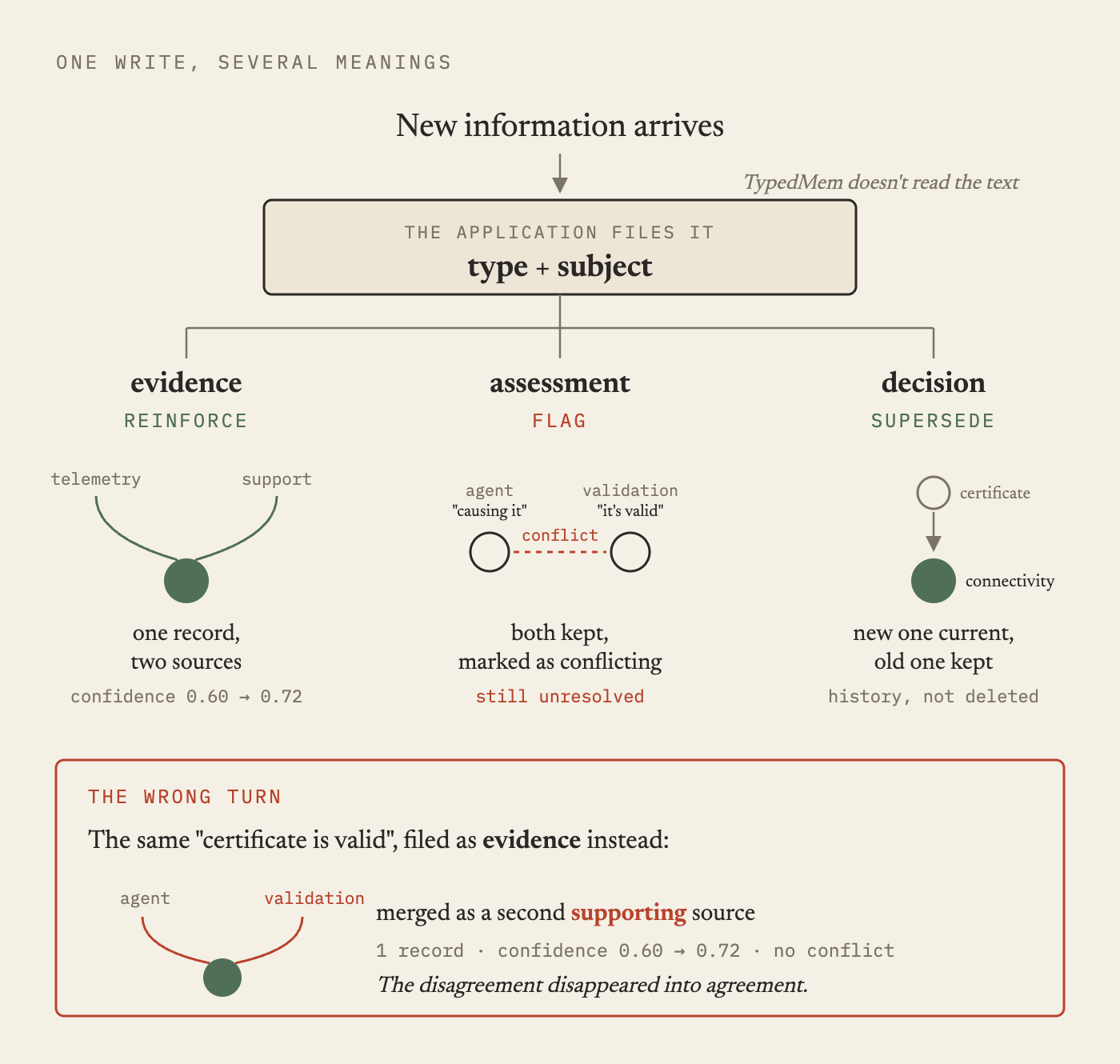
First, “new information arrived” is not one memory operation.
Second, recording how memory changed is not the same as recording why an agent changed its mind. I had blurred that distinction myself.
One write, several possible meanings
An operations agent is investigating why clients can’t connect to a logging service. Information arrives from runtime telemetry, support cases, a certificate validation system, and later telemetry.
The scenario uses three kinds of memory, each with its own transition rule:
| Memory type | When another record hits the same subject |
|---|---|
evidence |
reinforce: one record, more sources |
assessment |
flag: keep both, mark them as conflicting |
decision |
supersede: keep the old one in history, the new one is current |
Here is what happened in the run:
- Telemetry reports that certificate errors are associated with the
failures, and the agent stores it as
evidence. Support cases report the same thing. TypedMem doesn’t create a second record: it keeps one record with two sources, and its confidence rises from 0.60 to 0.72. - The agent stores its own
assessment: the certificate is causing the failures. The validation system reports that the certificate is valid, stored as anassessmenton the same subject. Both are kept and marked as conflicting. The conflict stays open: nothing later resolves it, and the memory layer doesn’t pretend otherwise. - The agent decides to investigate the certificate. Later, telemetry shows that failures correlate with lost connectivity to the logging service, and the agent revises its decision. The new decision supersedes the old one: the old one stays in history, and only the new one is current.
TypedMem didn’t discover any of these relationships
The text never decided anything. I did, when I told the system which kind of memory each piece of information was:
- telemetry and support cases are
evidence; - the two judgments about the certificate are
assessments about the same subject; - the investigation path is a
decision.
TypedMem then applied the rule each type declares. It doesn’t read the text: it matches records by type and subject, and the type’s rule decides what happens.
While writing this I ran the obvious mistake. I filed the validation result as
another evidence record on the same subject as the agent’s assessment. There was
no conflict. The store kept one record, whose text was still “The certificate
is causing client failures”. The validation system became its second
supporting source, and confidence rose from 0.60 to 0.72. The disagreement
disappeared into agreement.
That isn’t a bug in the policy engine. It shows the boundary: the memory layer can enforce semantics, but the application has to assign the right semantics first.
Authority is a policy, not the truth
In an early outline of this post I wrote that picking the more trusted source “silently turns authority into a truth oracle”. That was too strong.
Sometimes authority is exactly the rule you want. For TypedMem’s replace-style memory types, a newer record from a weaker source can’t displace an existing one from a stronger source: it is ignored. In an earlier measurement, typed memory with that rule scored 1.00 on the authority cases.
Other kinds of memory want disagreement to stay visible. That’s what the flag rule is for. And evidence wants agreement to accumulate.
        the same incoming information
                     │
                     ▼
       depends on the memory's contract
         ┌───────────┼───────────┐
         ▼           ▼           ▼
       veto         flag      reinforce
The point isn’t that authority is bad. It’s that different kinds of memory need different transition rules, not one universal resolver of truth.
What the event log recorded
Every transition is recorded. Grouped by what it means, the run’s history is:
- evidence added (telemetry)
- evidence reinforced (support cases)
- assessment added (the agent: the certificate is causing failures)
- competing assessment stored; both records flagged (validation)
- decision added (investigate the certificate)
- evidence added (connectivity)
- decision superseded (investigate connectivity)
The raw log is more detailed. Flagging and superseding touch both records, so they write paired events: nine events for these seven steps.
Replaying the whole log rebuilds the store exactly: the same six records. Replaying only the events before step 7 rebuilds the earlier state, in which the current decision was still “investigate the certificate”.
Memory history is not reasoning history
This is the part I got wrong.
The main figure of the first post had this caption:
The important object is not an isolated memory item. It is the transition structure that explains how the present emerged from the past.
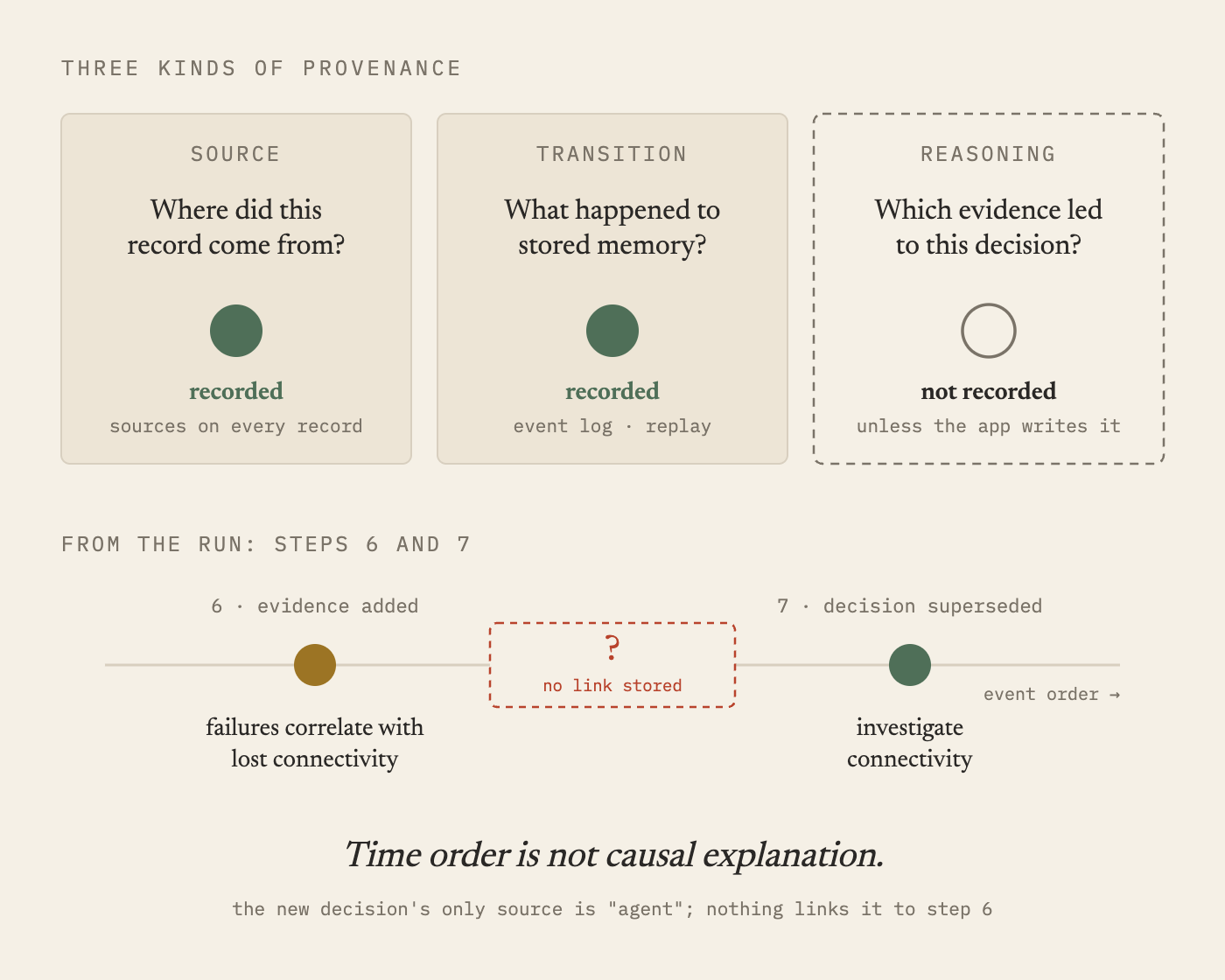
I would phrase that differently now. Here is what the implementation actually knows:
| Kind of provenance | Question | Recorded? |
|---|---|---|
| Source | Where did this record come from? | Yes |
| Transition | What happened to stored memory? | Yes |
| Reasoning | Which evidence caused this decision? | Only if the application records it |
The event log can tell me that the connectivity evidence was stored before the investigation decision changed. It cannot tell me that the evidence caused the change. In the run, the new decision’s only source is the agent, and nothing links it to the evidence.
Time order is not causal explanation.
It’s tempting to draw the investigation as one chain (telemetry → hypothesis → conflict → new evidence → decision revised). That drawing would claim knowledge the system never stored.
Replay has the same boundary. It answers “what did memory contain at this point?”, not “why did the agent decide that?”
Where the memory layer ends
I started with the idea that long-lived memory needs explicit state transitions. Implementing it made the boundary sharper:
- The application assigns meaning.
- The memory layer enforces the declared transition.
- The event log records what changed.
- None of these, by itself, records why the agent reasoned from A to B.
That leaves the question I don’t know the answer to yet. How much decision provenance belongs in a general memory layer? Should links from evidence to decisions be first-class memory structure, or stay application-specific?
If you’ve built long-running agents and had to answer “why did it decide that?”, I’d like to know where you ended up putting that link.
The scenario is a runnable example,
examples/incident_investigation.py.
It uses TypedMem’s public API, and a test pins its output, so the run described
here is the run you get.
Written while building AgentSeism. New posts by RSS.