Agent runtime · Field note 01
What does it take to actually replay an AI agent?
Abstract
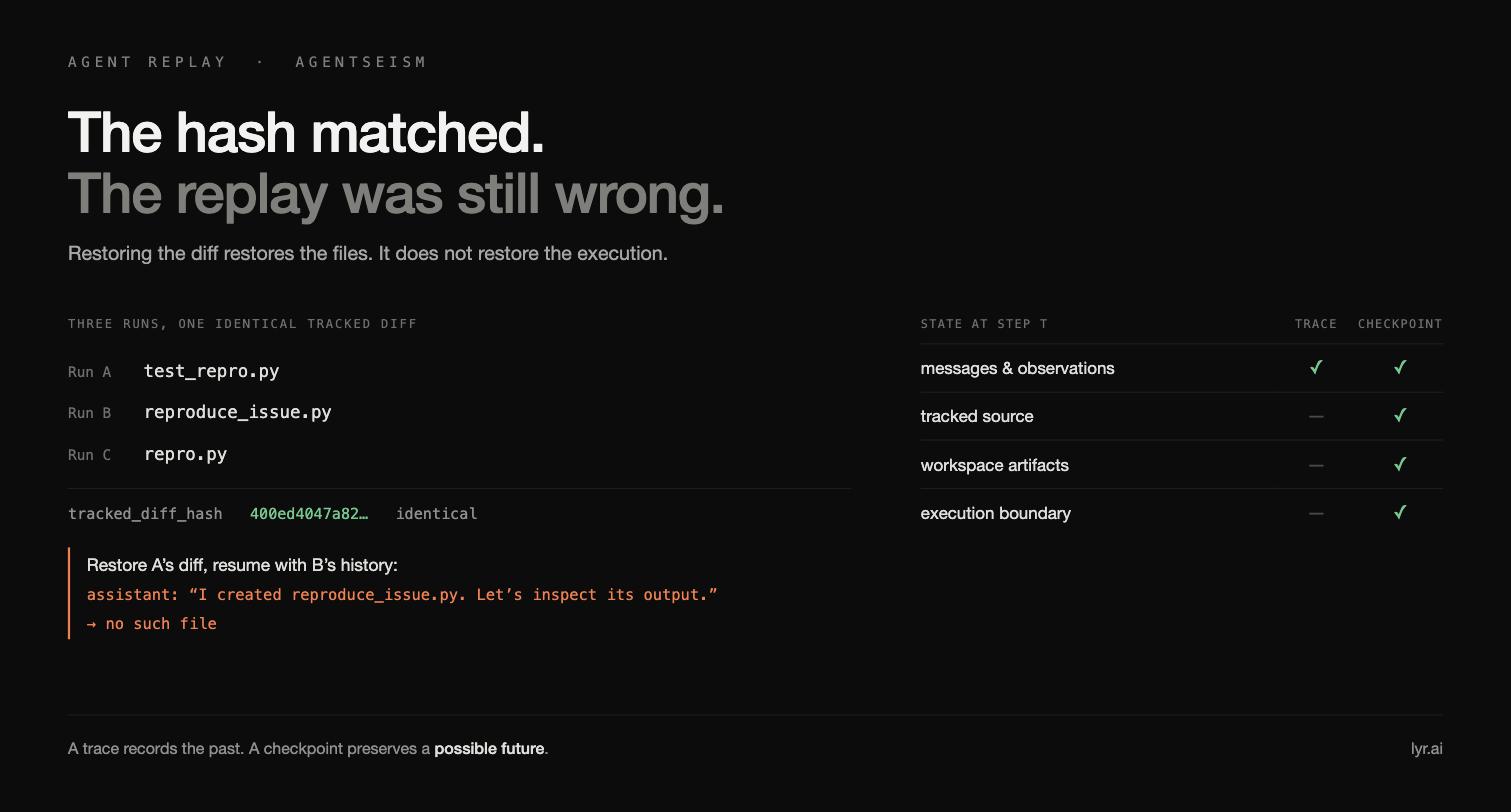
Replaying an AI agent sounds straightforward: save its conversation, restore the repository, and continue execution from the same point. In practice, I found that this is not enough.
While building controlled replay and fork experiments for AgentSeism, I needed to reconstruct coding-agent executions at an intermediate state and continue them under different experimental conditions. The requirement was stronger than ordinary tracing: a restored execution had to represent the same state that the original agent actually experienced.
This exposed several subtle problems. Repository state and agent state are different. Tracked source files and scratch workspace artifacts have different lifecycles. An environment step is not necessarily an agent step. A checkpoint can pass a source-state validation while silently losing files that later model messages refer to.
The resulting lesson is simple:
A trace tells you what happened. A replayable checkpoint must contain enough state to make the execution continue coherently.
This post describes what that required in practice, and proposes a minimal model for replayable long-running agents.
1. Why replay matters
Replay becomes useful as soon as an agent does more than answer a single prompt.
A long-running coding agent may inspect files, create reproduction scripts, modify source code, run tests, reject hypotheses, and accumulate observations over dozens of model calls. When such an execution fails, we often want to ask whether the failure can be reproduced, when the execution first became recoverable or unrecoverable, whether a different intervention from an earlier point would have changed the result, or whether a production incident can be resumed after infrastructure failure.
All of these require something stronger than logging.
A conventional trace provides        A replayable execution requires

messages                             messages
tool calls                           tool calls
observations                         observations
timestamps                                  +
                                     environment state
                                     workspace artifacts
                                     source state
                                     execution boundary
                                            ↓
                                     coherent continuation
The difference became concrete when I tried to fork two agent executions from the same repository state.
2. Same source state is not same agent state
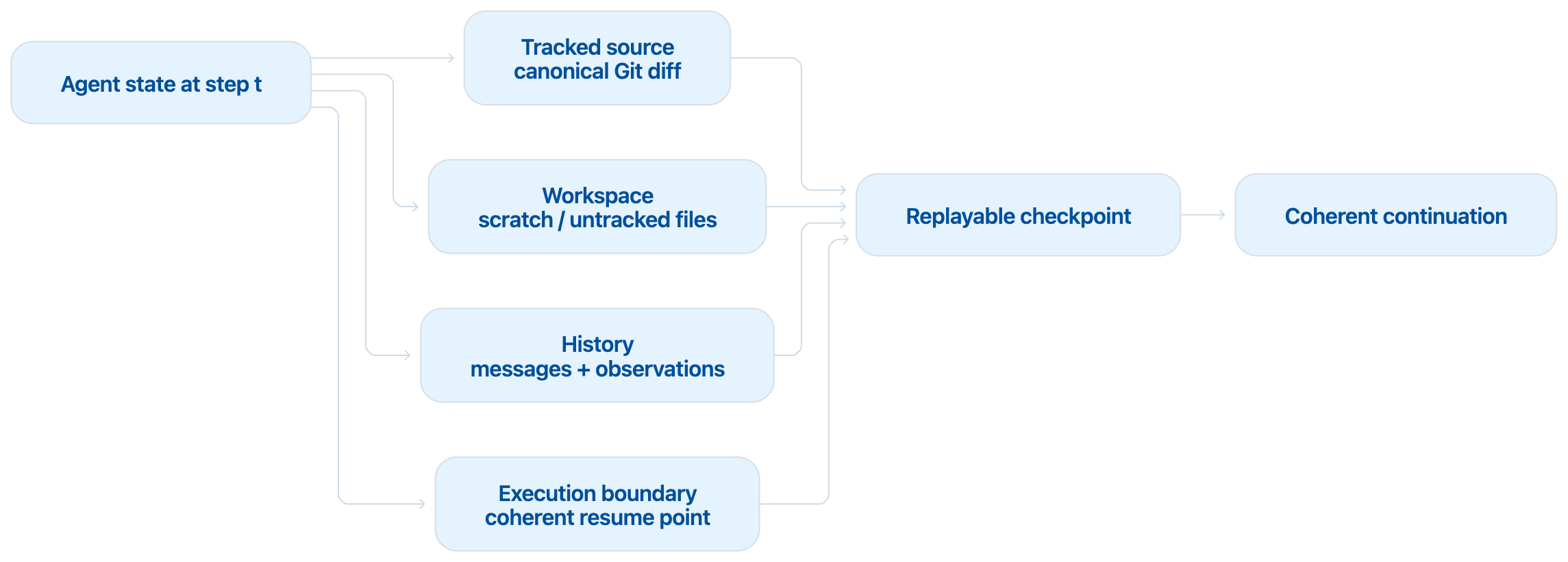
In one repeated SWE-bench experiment, several independent executions reached exactly the same tracked repository state. The canonical Git diff was identical. Their workspaces were not.
Different runs had independently created scratch files such as:
Run A    test_repro.py
Run B    reproduce_issue.py
Run C    repro.py
Their message histories also differed, because each execution had taken a different investigative path.
If I reconstructed only the Git diff from Run A but resumed using Run B’s
conversation, the restored agent might contain a message saying “I created
reproduce_issue.py. Let’s inspect its output.” while reproduce_issue.py did
not exist.
The source-state hash would still be correct. The replay would still be wrong.
This distinction matters beyond coding agents. Any agent that modifies an external environment can carry state outside its transcript.
3. A minimal replayable checkpoint
For the AgentSeism experiment, I ended up separating the checkpoint into three state layers.
Source state. The tracked repository modifications are stored as a canonical diff and independently fingerprinted:
\[S_t = H(\text{canonical tracked diff}_t)\]This answers a narrow but useful question: are two executions looking at exactly the same tracked source modifications?
Workspace state. The source fingerprint deliberately excludes untracked artifacts, because scratch files and source changes mean different things analytically. Replay, however, cannot ignore them. I therefore archive the untracked workspace separately and fingerprint it too. That gives two checks rather than one:
tracked_diff_hash      → what source changed?
workspace_diff_hash    → what execution artifacts exist?
Keeping these separate turned out to be more useful than collapsing everything into one hash.
Carried context. Finally, the agent needs the message prefix it had actually accumulated at the checkpoint, including observations generated by previous tool calls. The replay system records both the prefix and a digest, so a continuation can verify it received the exact archived context rather than another history of the same length.
The resulting checkpoint looks conceptually like:
Checkpoint(t)
├── tracked.diff
├── tracked_diff_hash
├── untracked.tar
├── workspace_fingerprint
├── messages.json
├── messages_digest
└── execution metadata
This is not a universal agent-state schema. It is the minimum state required for the coding-agent environment I was trying to reconstruct — and that qualification is the point: replay state should be defined by the environment’s causal surface, not by a generic list of fields.
4. The hardest bug: an agent step is not an environment step
One of the less obvious implementation problems came from the meaning of a “step.”
An assistant message can contain multiple tool actions. The environment may therefore transition several times before the agent receives another observation and produces its next message. If a checkpoint is taken between two actions belonging to the same assistant turn, the archived conversation may end with an assistant message rather than an observation. Resuming from that point can effectively ask the agent to speak twice.
Agent turn A
     │
     ├── action 1
     │      ↓
     │     S₁      observable ✓   resume ✗
     │
     ├── action 2
     │      ↓
     │     S₂
     │      ↓
     └── observation
            ↓
        checkpoint S₂   observable ✓   resume ✓
            ↓
       Agent turn B
The intermediate checkpoint represents a valid environment state, but not a valid agent continuation boundary. This forced a distinction between observable state and coherent fork point: a state can be useful for trajectory measurement without being safe to resume from.
In the implementation, message history is therefore archived only at coherent agent boundaries, while environment states can still be recorded after every action. It sounds like a small piece of bookkeeping. Without it, a replay experiment silently changes the protocol being studied.
5. Replay must be validated without the model
Another lesson: the model should not be used to test whether replay infrastructure works.
Before spending inference on a fork experiment, I built a zero-model replay validation. Given an archived execution, the validator reconstructs the checkpoint in a fresh container and verifies that the reconstructed state matches the original archive. For two experimental arms sharing the same tracked source state, it looks like this:
                 Shared source state S
                      400ed4047a82…
                    ╱              ╲
              Arm A                  Arm B
          workspace A              workspace B
          history A                history B
               │                        │
               ▼                        ▼
        fresh container          fresh container
               └──────────┬─────────────┘
                          ▼
                  validate invariants
The gate checks that the tracked source fingerprint equals the intended shared state, that each workspace fingerprint equals its archived donor, that each message prefix matches its archived digest, and that the checkpoint is a coherent continuation boundary. Only after all of those pass does a model continuation become scientifically meaningful.
The principle generalizes beyond research:
Infrastructure determinism should be validated independently from model behavior whenever possible.
Otherwise a failed replay gets attributed to model stochasticity when the actual problem is missing state.
6. Replay and re-execution are different
Several distinct operations get called “replay.”
Trace playback displays recorded events and requires almost no reconstruction. Re-execution starts the original task again with the same configuration, which measures reproducibility from the beginning but restores no intermediate state. Environment replay reconstructs the sequence of external state transitions produced by recorded actions. Agent continuation restores an intermediate execution state and asks the model to continue from there. Counterfactual fork restores the same controlled state several times while deliberately changing one component of the carried context or the intervention.
The last two are substantially harder, because their validity depends on the fidelity of the reconstructed checkpoint.

7. Why this matters for production agents
The immediate motivation was a controlled experiment, but the same problem appears in production.
Suppose a coding agent runs for forty minutes and the worker disappears. A system that stored only the original prompt and the current Git diff may technically be able to restart the task, but it cannot necessarily resume the execution the agent was performing.
The same applies to customer-support agents, browser agents, research agents and workflow agents. Their relevant state may include browser tabs, downloaded files, tool results, intermediate plans, external object identifiers, temporary credentials, or changes already made to remote systems.
A useful production checkpoint therefore has to answer:
What state must be reconstructed so that the resumed agent’s next decision is conditioned on the same world it previously observed?
That is a much stronger requirement than persistence. It also suggests that agent runtimes should make checkpoint boundaries explicit, rather than treating arbitrary trace events as resumable states.
8. From replay to steering
Replay becomes particularly interesting when it is combined with outcome labels.
Suppose repeated executions reveal that an agent is moving toward a region associated with higher failure probability — the question Experiment 01 ends on. If a previous state can be faithfully reconstructed, the runtime can intervene rather than simply report the failure afterwards:
observe → checkpoint → predict failure risk → rollback / fork
       → intervene → continue → measure outcome
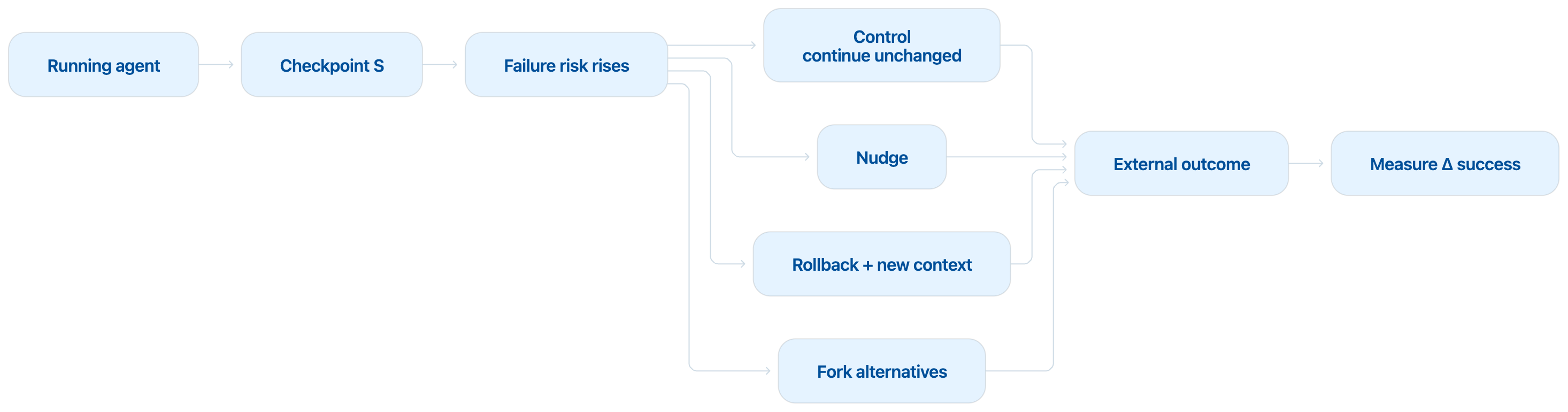
This is why replay infrastructure has become central to the direction of AgentSeism. The long-term goal is not to reproduce an agent’s mistake. It is to create a controlled point from which alternative futures can be tested.
Conclusion
I originally thought replaying a coding agent would mostly involve restoring its conversation and its repository. The implementation forced a more precise definition.
A replayable agent state is the set of information required to reconstruct a coherent continuation boundary: not only the artifact being modified, but the relevant environment state, workspace artifacts, carried observations, and execution protocol.
The most dangerous replay bugs are not crashes. They are restorations that appear valid because one fingerprint matches, while another part of the state was silently dropped.
For long-running agents, the useful distinction is therefore:
A trace records the past. A checkpoint preserves a possible future.
That matters for debugging today, and it matters more if agent runtimes eventually use replay, rollback and counterfactual forks to steer executions before they fail.
Written while building AgentSeism. New posts by RSS.