Agent reliability · Experiment 01
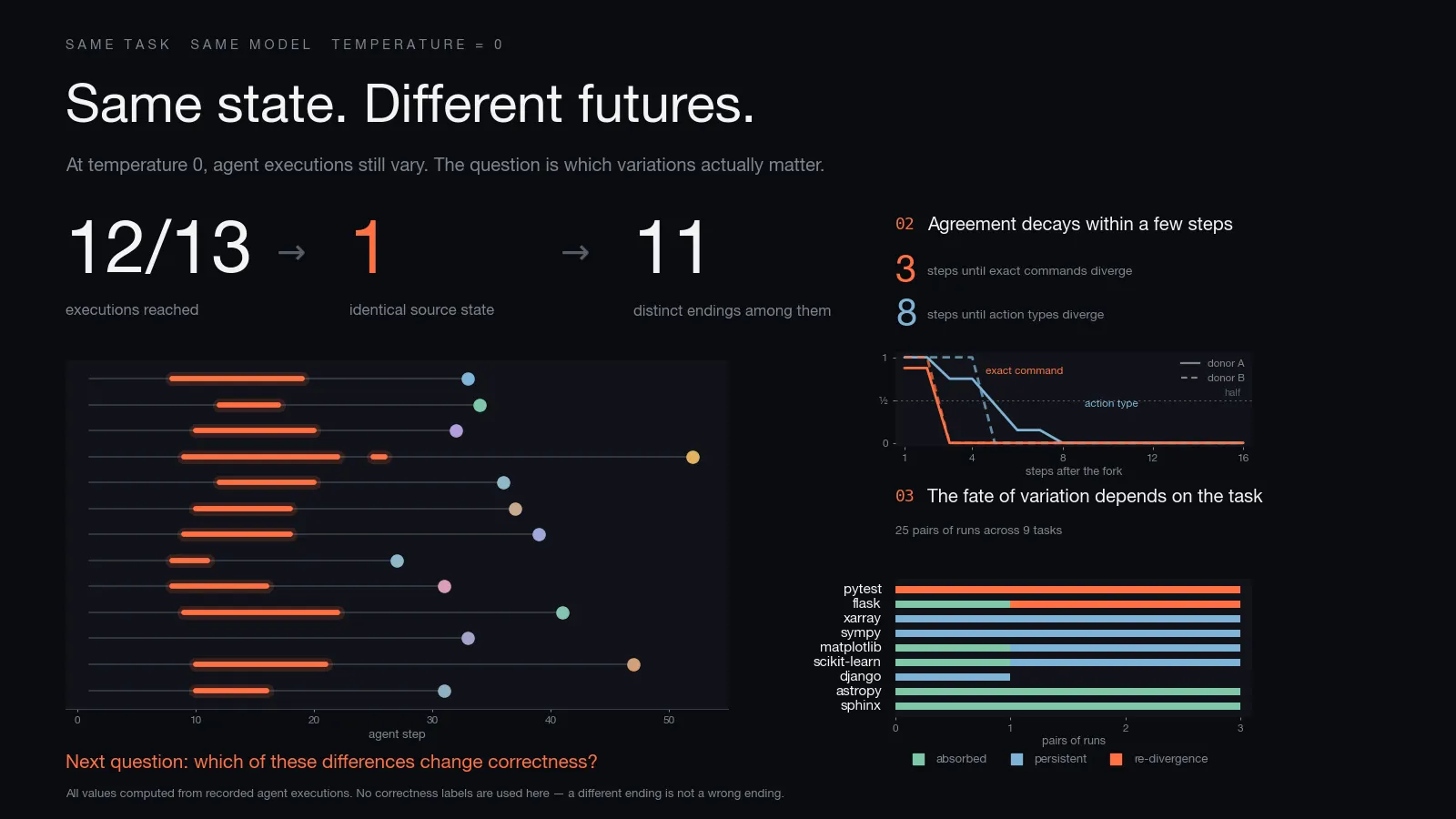
12 of 13 runs reached the exact same code state, then ended 11 different ways — even at temperature 0
Abstract
I ran the same coding agent on the same task repeatedly, using the same model,
configuration, and temperature=0. Twelve of thirteen executions reached the
exact same intermediate repository state. Those twelve runs subsequently ended
in eleven distinct source states.
At first, I thought the problem was variation itself. I no longer think that is the right framing. Different executions may still produce equally correct solutions. The more useful question is whether we can identify when harmless exploration becomes consequential divergence — and intervene before the agent fails.
1. Observation: temperature zero does not make an agent execution deterministic
An agent is not a single model invocation. It is a closed-loop system in which model outputs produce actions, actions change an environment, environmental changes produce new observations, and those observations become part of subsequent model context. Even a small difference early in this loop can therefore alter later tool calls and observations and eventually produce a substantially different execution.
To study this behavior, I repeatedly ran the same coding agent on SWE-bench
tasks using the same model and temperature=0. Rather than interpreting the
model’s reasoning text, AgentSeism records an objective environment-level
representation after each action. For coding tasks, a source state is the
canonical tracked Git diff of the repository against the task’s base commit.
Scratch files and other untracked workspace artifacts are recorded separately.
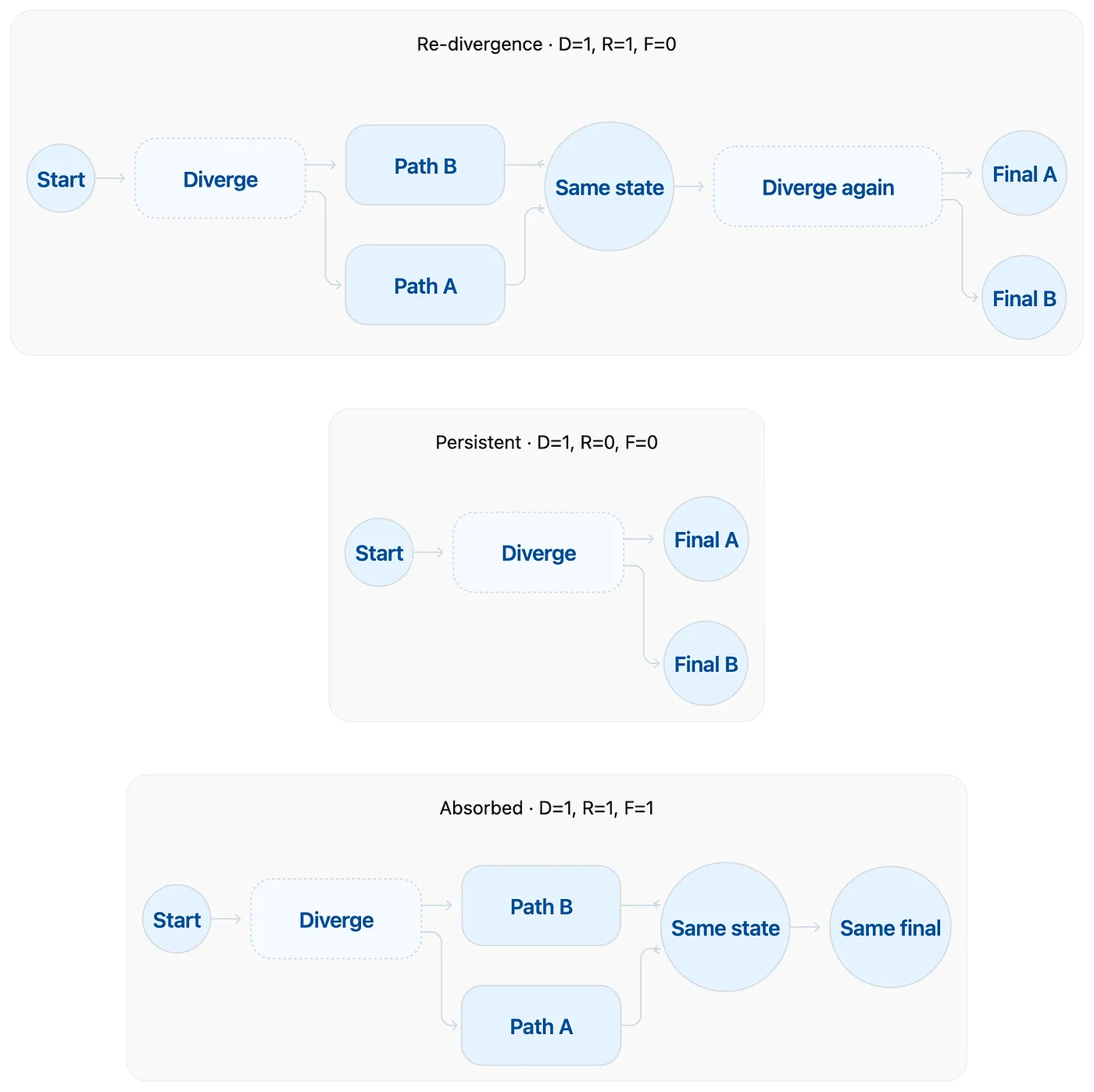
This representation revealed three recurring trajectory topologies. In absorption, two executions diverge but later reconverge and finish in the same source state. In persistence, they diverge and remain different through termination. In re-divergence, they diverge, later reach exactly the same non-empty source state, and subsequently separate again.
The important observation is not simply that executions differ. In one Pytest task, independent runs repeatedly reached the exact same non-empty source state and subsequently produced different final source states. Across the executions summarized in Figure 1, 12 of 13 runs reached that shared intermediate state, yet those runs ended in 11 distinct final states. This suggests that repository-source convergence does not imply convergence of the complete agent state, because different executions can arrive with different message histories, observations, and scratch workspace artifacts.
2. Reframing the problem: variation is not failure
My initial framing treated persistent or re-divergent trajectories as evidence of instability. That interpretation is too strong. Two executions may follow different paths and produce different patches while both satisfy the task specification. Conversely, an agent can behave very consistently and repeatedly produce the same incorrect answer. Behavioral reproducibility and task reliability are therefore different quantities.
For coding agents, this distinction can be measured without relying on another
LLM as a judge. SWE-bench provides external test-based signals through
FAIL_TO_PASS and PASS_TO_PASS, allowing each terminal execution to receive
an independent correctness label. The next stage of the analysis is therefore to
augment trajectory measurements with these labels and ask whether particular
forms of execution variation are associated with mixed outcomes on the same
task.
This motivates a narrower definition of the problem:
Consequential divergence is execution variation that propagates into a task-relevant outcome difference.
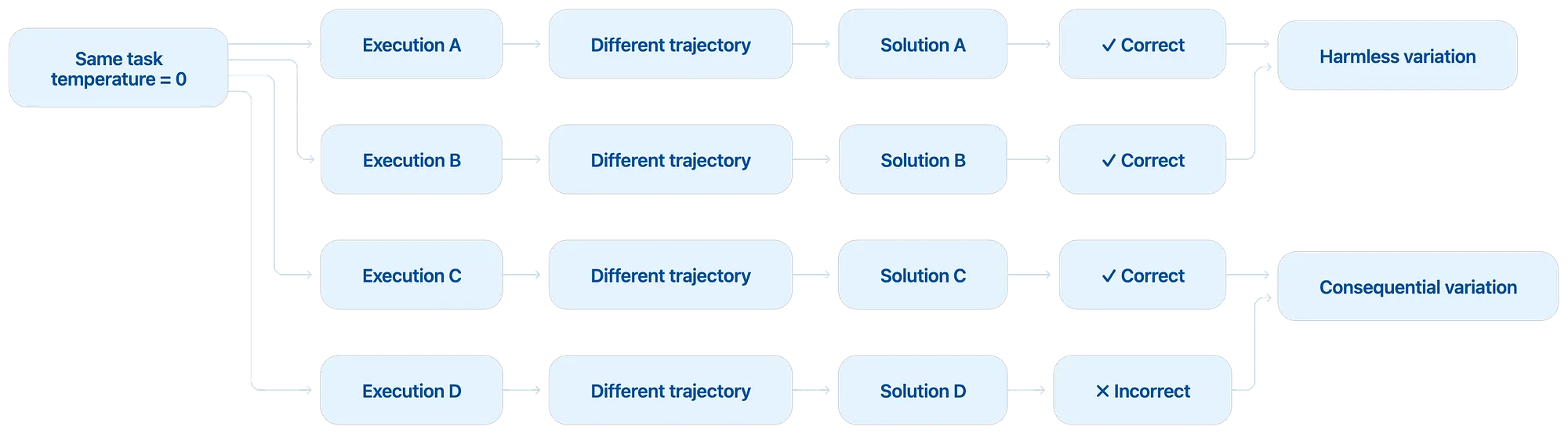
Correctness is the first outcome I plan to study because it has an external label, although the same framework could later include latency, cost, safety violations, or other application-specific outcomes.
Under this definition, the goal is explicitly not to make agents deterministic. A system that produces many different trajectories but succeeds reliably may be preferable to a deterministic system that consistently makes the same mistake. The useful question is which execution differences provide evidence that an agent is moving toward failure.
3. From measurement to intervention
Adding outcome labels changes AgentSeism from a trajectory-analysis problem into a sequential reliability problem. For a trajectory observed through step \(t\), the quantity of interest becomes conceptually
\[P(Y = \text{failure} \mid \tau_{\leq t}),\]where \(\tau_{\leq t}\) represents the execution history observed so far. This formulation creates two separate engineering questions: where should an agent be steered, and how should it be steered?
3.1 Where to steer
The first divergence from a common or previously successful trajectory is not necessarily a useful intervention point, because the difference may later be absorbed or may lead to another correct solution. Intervention should instead occur only when enough evidence has accumulated that the current execution has an elevated probability of failure.
Waiting until failure probability is maximal is also insufficient, because by then the execution may be difficult or expensive to recover. The useful intervention region is therefore the intersection between predictability and recoverability: failure has become distinguishable from normal exploration, but changing the trajectory can still improve the outcome.
A practical experiment would begin with repeated executions carrying external correctness labels. At every observed state or transition, AgentSeism can compare prefixes from successful and failed runs and ask how early their outcome distributions become distinguishable. This produces a failure-risk estimate over the trajectory rather than a binary anomaly detector.
Recoverability must then be measured separately. Candidate states can be archived and replayed, and controlled continuations can test whether interventions from that point still change the success probability. A state with high predicted failure risk but no effective intervention is useful for diagnosis but too late for steering. A state with moderate predictive power and a large intervention effect may be a substantially better control point.
\[\text{SteerValue}(t) \propto \text{FailureRisk}(t) \times \text{Recoverability}(t),\]although the exact scoring function should be learned from experiments rather than assumed in advance.
                        FINAL FAILURE
                             ✕
                             ▲
                             │
trajectory ──●────●────●────●────●────●──→
             │    │    │    │    │
             │    │    │    │    └─ too late
             │    │    │    │       risk high
             │    │    │    │       recovery low
             │    │    │    │
             │    │    └────┴──── STEERING WINDOW
             │    │              failure predictable
             │    │              recovery still possible
             │    │
             └────┴─ too early
                    insufficient evidence
 probability

1.0 |                         Failure risk
    |                       ╭──────────────
    |                    ╭──╯
    |                 ╭──╯
0.5 |──────────────╭──╯
    |              │
    | ╲
    |  ╲_____________________ Recoverability
0.0 +────────────────────────────────────→ step
             █████████
             STEERING
              WINDOW
3.2 How to steer
Once a candidate intervention point is identified, the next problem is causal rather than predictive. Knowing that a trajectory is likely to fail does not tell us which action will improve it.
AgentSeism already has the primitives needed to begin studying this question.
Its archival layer records canonical tracked source state, message history, and
untracked workspace artifacts; replay reconstructs an execution state; and
ForkAgent can create controlled continuations from a common source state.
These mechanisms allow different interventions to be compared from the same
starting point.
The simplest experimental design is to retain an untreated continuation as a control and compare it with increasingly strong interventions. A nudge can ask the agent to re-check a particular assumption or piece of evidence without providing a solution. A context intervention can alter carried execution context when there is evidence that previous history is contributing to failure. A rollback can restore a previously observed state with a better empirical outcome distribution. A fork-and-select intervention can generate several short continuations from a recoverable state and continue the branch with the lowest estimated failure risk.
The relevant metric is not whether the intervention makes trajectories look more similar. It is the change in externally measured success:
\[\begin{aligned} \Delta_{\text{success}} &= P(Y = \text{correct} \mid do(I)) \\ &\quad - P(Y = \text{correct} \mid do(\text{no intervention})). \end{aligned}\]This distinction is important because an intervention that reduces trajectory variance without increasing correctness has not improved reliability. Similarly, a fork-and-select strategy that improves correctness but doubles inference cost may only be useful for sufficiently high-value tasks. Steering should therefore eventually be evaluated jointly on outcome improvement and intervention cost.

The research program implied by this loop is straightforward even though the individual problems are not. First, existing trajectories need external correctness labels so that harmless and consequential variation can be separated. Second, larger sets of labeled repeated executions can be used to estimate when failure becomes predictable. Third, archived states can be replayed to measure where failure remains recoverable. Finally, randomized or otherwise controlled interventions can estimate which steering actions actually increase success.
4. Relationship to harness engineering
Harness engineering already provides many of the mechanisms needed to improve long-running agents, including context management, verification, retries, evaluators, structured planning, and recovery. AgentSeism is not intended to replace this layer. The narrower problem I am interested in is deciding when these mechanisms should be invoked, which intervention should be used, and whether the intervention actually improves an externally measured outcome.
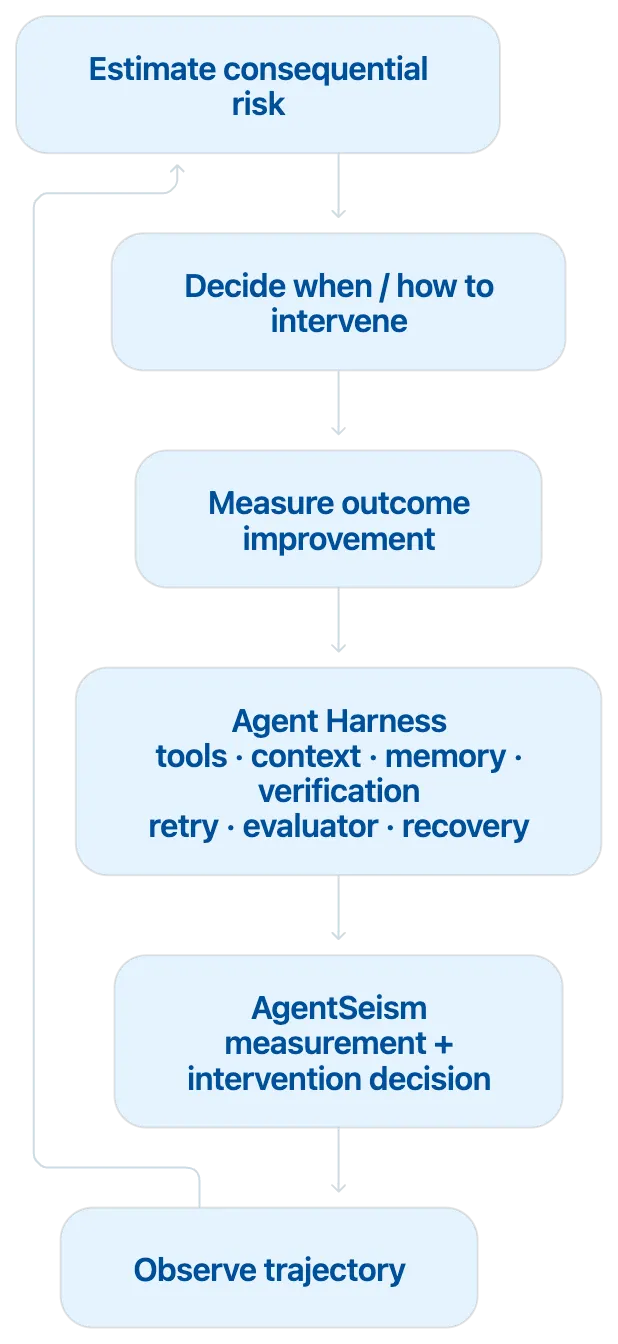
This distinction matters because execution variation is not necessarily failure. An agent taking an unfamiliar path may still reach a correct solution, while an unnecessary retry, context reset, or rollback may destroy useful exploration. I therefore see AgentSeism as a potential measurement and decision layer within an agent harness: it observes execution trajectories, identifies variation associated with outcome risk, estimates when intervention remains useful, and evaluates interventions against an untreated continuation.
5. Practical implications today
Even before automatic steering is solved, these experiments suggest several
practical design principles for long-running agents. Setting temperature=0
should not be treated as an end-to-end reproducibility mechanism. Systems that
need meaningful replay should preserve execution context and relevant workspace
state rather than storing only the model configuration or final artifact. A
different trajectory should not automatically be classified as anomalous,
because behavioral diversity may be harmless. Most importantly, intervention
should be grounded in task outcomes rather than distance from a canonical
trajectory.
These principles also change how I think about agent observability. A trace viewer can explain what happened after an execution finishes. A reliability system should eventually answer a harder question while the execution is still running: given what has happened so far, is this agent becoming more likely to fail, is it still recoverable, and which intervention is most likely to improve the outcome?
6. Next experiments
The immediate next step is intentionally simpler than building an online controller. I plan to attach SWE-bench correctness labels to the completed trajectories and determine whether the behavioral structures already measured by AgentSeism correspond to meaningful outcome variance. In particular, the important cases are tasks where repeated executions under the same configuration produce a mixture of correct and incorrect outcomes, because those tasks provide the data needed to study consequential divergence.
In parallel, the current fork experiment tests a narrower causal question raised by re-divergence: when two executions reach the same repository source state but carry different histories and workspace artifacts, does that carried context causally change their subsequent repair distribution? Exact terminal-state matching is useful for understanding the mechanism, but correctness will ultimately be the more important outcome. If different histories produce different patches but all patches are correct, the variation is mechanistically interesting but not yet a reliability problem.
If these experiments establish both mixed outcome variance and recoverable intermediate states, the next stage will be a controlled steering benchmark. Each candidate state would be forked into an untreated control and one or more intervention arms, with success rate and intervention cost measured independently. That experiment would directly test the product hypothesis behind AgentSeism: not whether agent trajectories can be made identical, but whether consequential divergence can be detected early enough, and corrected reliably enough, to improve end-to-end task success.
Conclusion
Repeated long-horizon agent executions can vary substantially even at
temperature=0, and identical intermediate source states do not necessarily
imply identical futures. Those observations are useful measurements, but they
are not themselves evidence of unreliability.
The more important distinction is between behavioral variation and consequential variation. The next phase of AgentSeism is therefore centered on external outcome labels, early failure prediction, recoverability, and controlled intervention. The long-term objective is not deterministic agents; it is an execution system that permits useful exploration while recognizing when an agent is genuinely going off track and steering it back when doing so measurably improves the outcome.
Written while building AgentSeism. New posts by RSS.