Agent reliability · Method note 01
One run is not an evaluation
Abstract
I used to think evaluating an AI agent was conceptually straightforward: freeze a task and configuration, run the agent, record the outcome, compare scores.
Repeated executions changed that view.
The same agent, task, model and temperature=0 configuration can produce
materially different executions. More importantly, the evaluation system itself
can create artifacts that look like model behavior: a context-window limit can
selectively remove long trajectories, a reasonable-looking state definition can
create false reconvergence, an infrastructure timeout can masquerade as agent
failure, and an obviously “cold” benchmark run can already have been warmed by
an earlier failed measurement.
These are not implementation annoyances. They change what an evaluation result means.
My current view is that agent evaluation needs at least five separate layers: a frozen execution protocol, repeated runs, explicit termination and censoring semantics, validated behavioral measurements, and an external task-level outcome. Only after those are separated does it make sense to compare agents, or to claim that a behavioral difference matters.
This post records the evaluation assumptions that broke while I was building AgentSeism, and the protocol I use now.
1. “One run represents the agent”
Suppose Agent A solves a benchmark task and Agent B fails it. Which agent is better? With one execution each, we barely know.
A long-running agent is not a single model call. It repeatedly generates actions, modifies an environment, observes the result, and folds those observations into subsequent context, so small differences propagate through the execution.
In my coding-agent experiments, repeated executions used the same task, model,
agent configuration and temperature=0, and still did not reliably follow the
same trajectory. Some differences disappeared, some persisted, and some
executions diverged, reached the exact same repository state, and diverged
again.
A single execution therefore measures something closer to
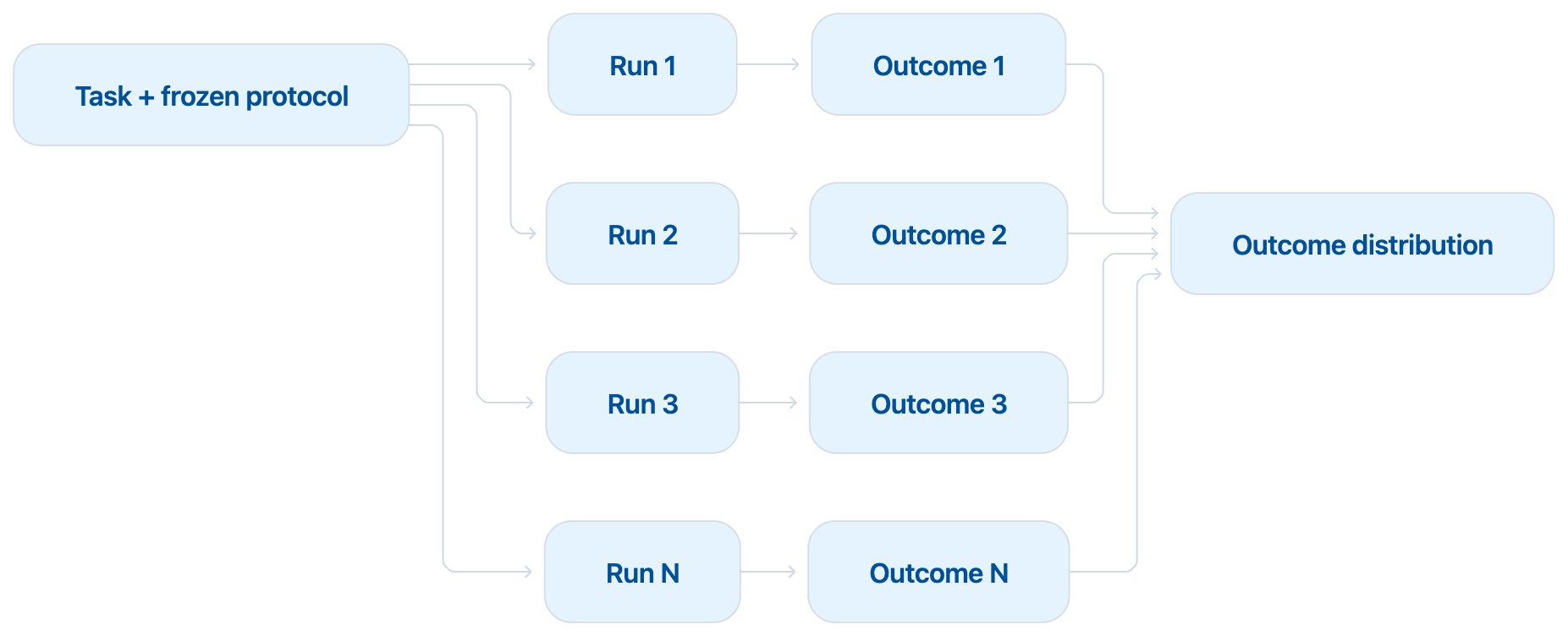
\[Y_{i,r}\]— the outcome of run \(r\) on task \(i\) — than an intrinsic property of the agent. What we usually care about is a distribution:
\[P(Y \mid \text{agent}, \text{task}, \text{protocol}).\]Repeated execution is not simply a way to make an average more precise. It is how you find out whether the thing being evaluated has meaningful run-to-run variance at all.
2. “A failed run is an agent failure”
Repeated runs immediately raise another question: what counts as an outcome?
In one experiment I configured the serving system with a 32k context limit.
Several trajectories terminated with ContextWindowExceeded. One task — Seaborn
— lost all three of its runs that way.
It would have been easy to record success: false and fold those into the
agent’s accuracy. But the model itself supported a much longer context. The 32k
boundary was an infrastructure choice I had made. Those executions answered
“can this agent complete the task under my 32k serving constraint?” — not “can
this agent solve the task?”
The distinction got sharper when I noticed which executions were being removed. Long trajectories involve more exploration and accumulate more context, so context-window censoring was not random. The experiment was preferentially deleting a particular kind of execution: a missing-not-at-random pattern.
I now separate at least four termination classes.
| Termination | Interpretation |
|---|---|
| Completed / submitted | agent produced a terminal outcome |
| Agent failure | the agent itself terminated unsuccessfully |
| Infrastructure failure | endpoint, container, transport or runtime failed |
| Censored | an experimental boundary stopped the trajectory |
The exact taxonomy depends on the system. Collapsing these into success=0 can
distort an evaluation badly.
                       EXECUTION ENDS
                             │
             ┌───────────────┼───────────────┐
             │               │               │
             ▼               ▼               ▼
         COMPLETED      AGENT FAILURE    NOT AN AGENT FAILURE
                                         ┌──────┴──────┐
                                         ▼             ▼
                                  INFRA FAILURE     CENSORED
                                  endpoint died     context limit
                                  container crash   step limit
                                  transport error   time boundary
Figure 3. Failure is not one bucket. The question is not “did this run finish?” but “what process caused observation to stop?”
3. “Measurement code cannot manufacture a finding”
The most uncomfortable evaluation bugs are not crashes. They are measurements that produce plausible numbers. I hit three.
A “cold” run that was already warm
While measuring prefix caching, a script assumed repeat == 0 → cold and
repeat == 1 → warm. Reasonable enough. But earlier executions had already sent
the request and populated the cache before the script crashed while printing its
results. On rerun, the nominally first measurement was already warm.
The eventual data made it visible: a genuinely cold ~28.5k-token prefill took about 12.1 seconds, while a cached repetition took about 0.43 seconds. Earlier ~14k measurements that had looked inexplicably fast were not evidence of exceptional cold-prefill performance — the cache was already populated.
The bug was not in vLLM. It was in the assumption that the first recorded measurement is the first system exposure. Experimental state can survive a failed measurement.
A reconvergence that never happened
AgentSeism compares trajectories by repository source state. The first implementation treated two runs as reconverged if they shared a source-state hash after diverging, and the analysis produced a lot of apparently anomalous pairs.
The reason was embarrassing. The hash e3b0c442… is SHA-256 of the empty diff.
Every execution occupies that state before it modifies anything, so two
trajectories could “reconverge” purely by both having changed nothing yet. Once
the empty state was excluded, the anomalies largely disappeared.
Nothing about the agent changed. Only the measurement did.
Two “different outcomes” that were the same source state
Another pair appeared to finish with different patches even though their final tracked source hashes were identical. One submission contained roughly 18 KB of extra untracked scratch content; the actual tracked modification was the same ~720-byte code change in both.
Two different objects had been compared: a submission string and a canonical tracked repository state. Both are legitimate measurements of different questions. If the question is whether the agent produced the same source repair, the tracked state is the right outcome; if it is whether the agent submitted the same artifact, the string may be. The bug was silently treating the two as interchangeable.

4. “Fixing a measurement is a neutral act”
There is a dangerous moment in any exploratory experiment: the data look strange, you find a flaw in the analysis, you fix it, the results look cleaner — and then another strange result appears, and you fix that too. At some point “debugging the measurement” becomes indistinguishable from adjusting the analysis until the data tell a satisfying story.
I ran into exactly this.
The empty-state reconvergence issue was clearly a measurement bug: an unmodified repository should not count as meaningful reconvergence. But another pattern survived the fix — some trajectories reached the same non-empty source state and later diverged again.
My original classification treated that as anomalous, because it implicitly assumed that once trajectories reconverge they stay reconverged. The data showed the assumption was false. Changing the instrumentation to make those cases disappear would no longer have been fixing a measurement; it would have been deleting a real topology my conceptual model failed to represent.
So I kept the observation and expanded the representation to a triple \((D, R, F)\) — divergence, non-empty reconvergence, final convergence — which describes the three observed cases directly:
absorbed        1 1 1
persistent      1 0 0
re-divergence   1 1 0
Fix instrumentation when it fails to measure the construct you defined. Change the construct only when you are willing to say the original hypothesis or representation was incomplete.
Those are different scientific operations and should leave different records.
5. “Writing the design down makes it reproducible”
Preregistration sounds excessive for an engineering project. I found it useful for a blunt practical reason: it stopped me from making dozens of individually reasonable decisions after seeing the data.
For one experiment I froze, in advance: task-selection rules, run count, model and serving configuration, state representation, divergence and reconvergence definitions, treatment arms, outcome metric, stop conditions, and the handling of infrastructure failures.
It did not prevent mistakes. One donor-selection rule later produced two experimental arms with identical terminal targets, which made the planned treatment contrast unidentifiable.
What mattered was what happened next. There were other runs in the same dataset
that would have produced different terminal targets, and picking one of those
would have been easy. The gate returned UNIDENTIFIABLE, Phase B did not run,
the rule was amended and documented, and the amendment was applied only to a new
sample.
Preregistration did not make the original design correct. It made the design failure visible, which turned out to be the more useful property.
6. Repetition does not rescue a bad metric
Suppose I run an agent 100 times and precisely estimate how often it produces different patches. If all of those patches are correct, I have precisely measured a behavioral difference that may not matter.
This was the most important conceptual correction in the AgentSeism work. Initially I focused on trajectory variation: do executions diverge, do they reconverge, do they finish in different source states? Those are useful behavioral measurements. They are not task outcomes.
For coding agents the stronger outcome is externally measurable —
FAIL_TO_PASS and PASS_TO_PASS give a correctness label independent of the
agent’s own reasoning. That creates two layers: behavioral variation and
consequential variation. Different trajectories with the same correctness may
be harmless diversity; similar trajectories that repeatedly fail may be stable
unreliability.
             REPEATED EXECUTIONS
                     │
                     ▼
         How much does behavior vary?
                     │
              trajectory metrics
                     ▼
        ┌─────────────────────────┐
        │ Behavioral variation    │
        └────────────┬────────────┘
                     │  + external labels
                     ▼
        ┌─────────────────────────┐
        │ Consequential variation │
        │ Did the variation       │
        │ change correctness?     │
        └─────────────────────────┘
Figure 5. More repetitions reduce uncertainty about the metric you chose. They do not make the metric more meaningful.
This is the direction of the next experiments: attach correctness labels to repeated trajectories, and find out which execution differences actually correlate with — or cause — failure. It is the same question Experiment 01 ended on.
7. “Evaluation measures the model”
An agent evaluation result belongs to an entire protocol. “Agent X achieves 72% accuracy” is incomplete without knowing what execution process produced the number: model and exact revision, sampling configuration, tool definitions, agent implementation, context-window limit, step limit, retry policy, container version, serving engine, concurrency policy, termination semantics, scoring implementation.
Some of those look like infrastructure trivia. They still change the distribution being measured.
I considered running several AgentSeism trajectories concurrently to cut GPU rental time. From a serving perspective that is obviously right — continuous batching improves utilization. But the experiment was studying run-to-run variation under temperature-zero inference, and changing concurrency changes batch composition and potentially the numerical execution path. A serving optimization would have altered the stochastic process under study.
In production I would enable concurrency. For that experiment I kept runs sequential. The correct configuration depends on the question.
8. The protocol I use now
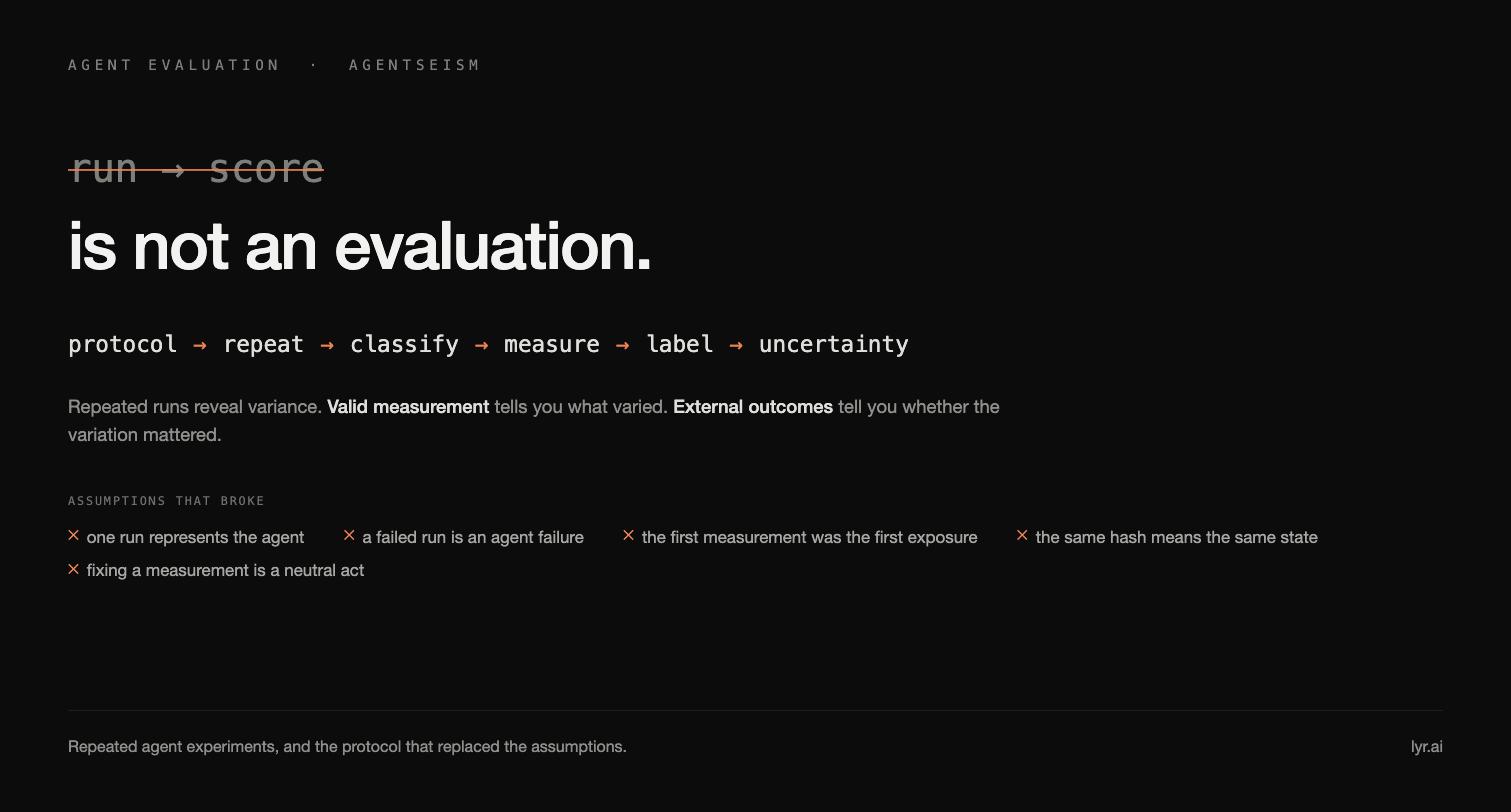
The pipeline I want looks less like run → score:

In practice, six questions before I trust an agent-evaluation result:
- Is the protocol frozen? Can I state exactly what system produced these executions?
- Do I have repeated runs? Have I measured run-to-run variability rather than assuming it away?
- Do termination classes have explicit semantics? Can I separate agent failure from infrastructure failure and censoring?
- Has the measurement been validated? Do the hashes, state representations or judge scores correspond to the construct I claim to measure?
- Is there an external outcome? Am I measuring task success, or only behavioral difference?
- Is uncertainty visible? Does the reported result reflect the distribution I actually observed?
If I cannot answer these, adding more benchmark tasks is usually not the first thing I need.
9. What I still don’t know
This protocol solves part of the problem. Repeated executions get expensive, and the right number of repetitions depends on the agent’s variance and on the decision being made. Some evaluations have deterministic external labels; others need human or model judges, which introduce another layer of measurement noise. Production agents also operate on non-stationary task distributions, which makes any fixed benchmark an incomplete proxy for deployed behavior.
The question I care about next is more specific: once repeated executions carry external correctness labels, can we identify where successful and failed trajectories begin to become distinguishable, before termination?
If so, evaluation stops being only retrospective. Instead of “which agent scored higher?”, the question becomes “when did this execution become more likely to fail, and could an intervention at that point have changed the outcome?” That is the bridge between agent evaluation and agent reliability.
Conclusion
The biggest change is that I no longer treat the benchmark score as the beginning of the analysis. It is the end of a measurement pipeline.
Before trusting the score I want to know what protocol generated it, how much executions vary, why each run terminated, whether the instrumentation measures what I think it measures, and whether behavioral differences are grounded in an external outcome.
So the principle is not simply run the agent more than once. It is:
Repeated runs reveal variance. Valid measurement tells you what varied. External outcomes tell you whether the variation mattered.
Only then does it seem fair to call the result an evaluation.
Written while building AgentSeism. New posts by RSS.