Agent reliability · Method note 03
Why agent CI can't be treated like deterministic tests
Continuous integration rests on one assumption so basic we rarely say it out
loud: run the same code on the same input and you get the same result. A
test that passed on main and fails on your branch is evidence against your
branch. That assumption is what makes a red check mean something.
AI agents break it.
Run an agent twice on the same task, with the same code, model and prompt, and it can read different files, call tools in a different order and end somewhere else. Sometimes it succeeds both times, sometimes once. So when a pull request touches the agent and the eval score moves, what should the check believe?
A check that failed for the right reason
Here is a pull request that looks like a harmless refactor. It changes one
line in a checkout handler, and the field it now reads, amount_cents, does not
exist.
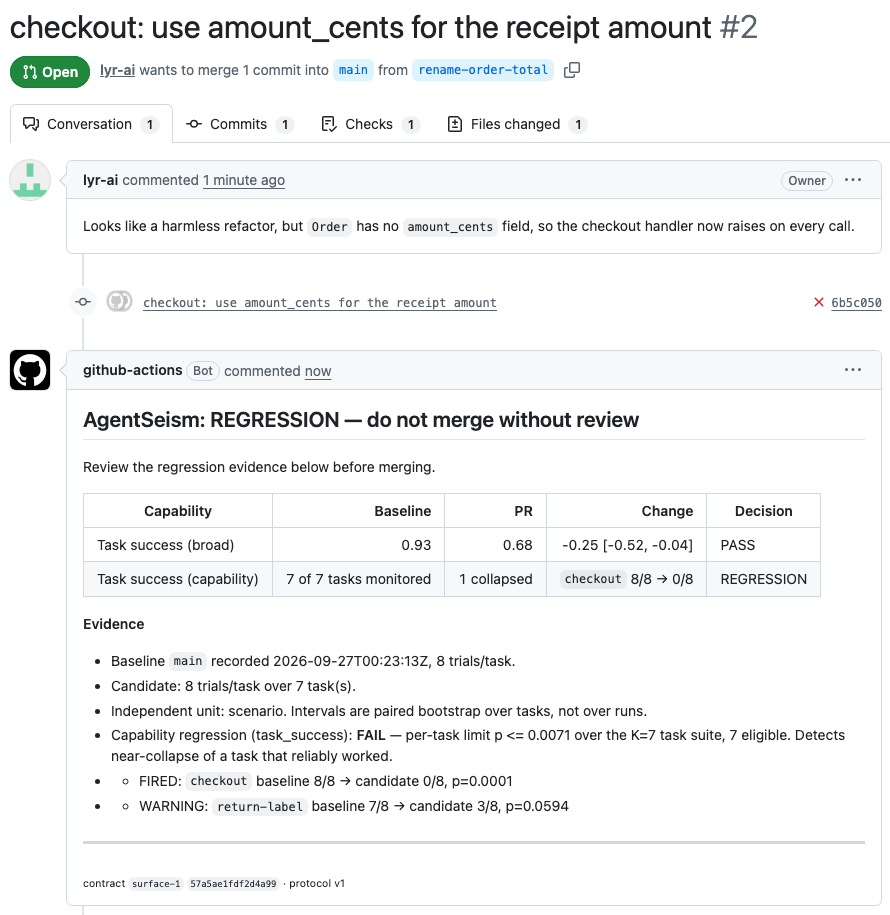
The check ran each of seven tasks eight times on main and eight times on the
branch. Overall success fell from 0.93 to 0.68, and two things happened that
ordinary CI has no vocabulary for:
- The broad reliability check passed. The evidence supported some deterioration, but not a suite-wide drop of at least the 10-point threshold declared in advance.
- The check still failed, because
checkout, which had succeeded 8 of 8 times onmain, succeeded 0 of 8 times on the branch.
A third detail is easy to miss: return-label went from 7/8 to 3/8 and was
flagged as a warning, not a failure. Its success rate didn’t change in this
PR, so that drop is pure run-to-run wobble, and a warning is the right amount
of alarm for it.
A single pass/fail test cannot express any of that. Neither can a single eval score.
One run is a sample, not a replay
A deterministic test is a replay: run it again and you learn nothing new. An agent run is a sample from a distribution of possible runs. That changes what a comparison between two branches can tell you, in three ways.
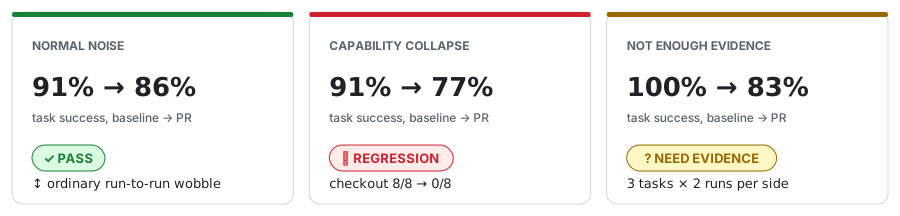
seism demo, which feeds fixed, stated outcomes through the real decision engine. They illustrate the cases and are not evidence.1. Scores move when nothing changed
On a real coding agent (mini-swe-agent with Claude Haiku 4.5, on five SWE-bench tasks run five times each), we ran an unchanged candidate against its own baseline. Success went from 0.92 to 0.88. One task went from 3/5 to 2/5 with no code change at all.
A deterministic mindset reads that as “the PR made it worse”. It didn’t. There was no PR. A check that blocks on this trains developers to click “re-run” until it goes green, and after that nobody trusts it.
2. Averages hide breakage
The opposite failure is quieter. In the pull request above, the average fell 25 points, but not evenly: most of it was one task collapsing completely. Averaged over the suite, a total failure of one capability looks like a moderate, uncertain drop.
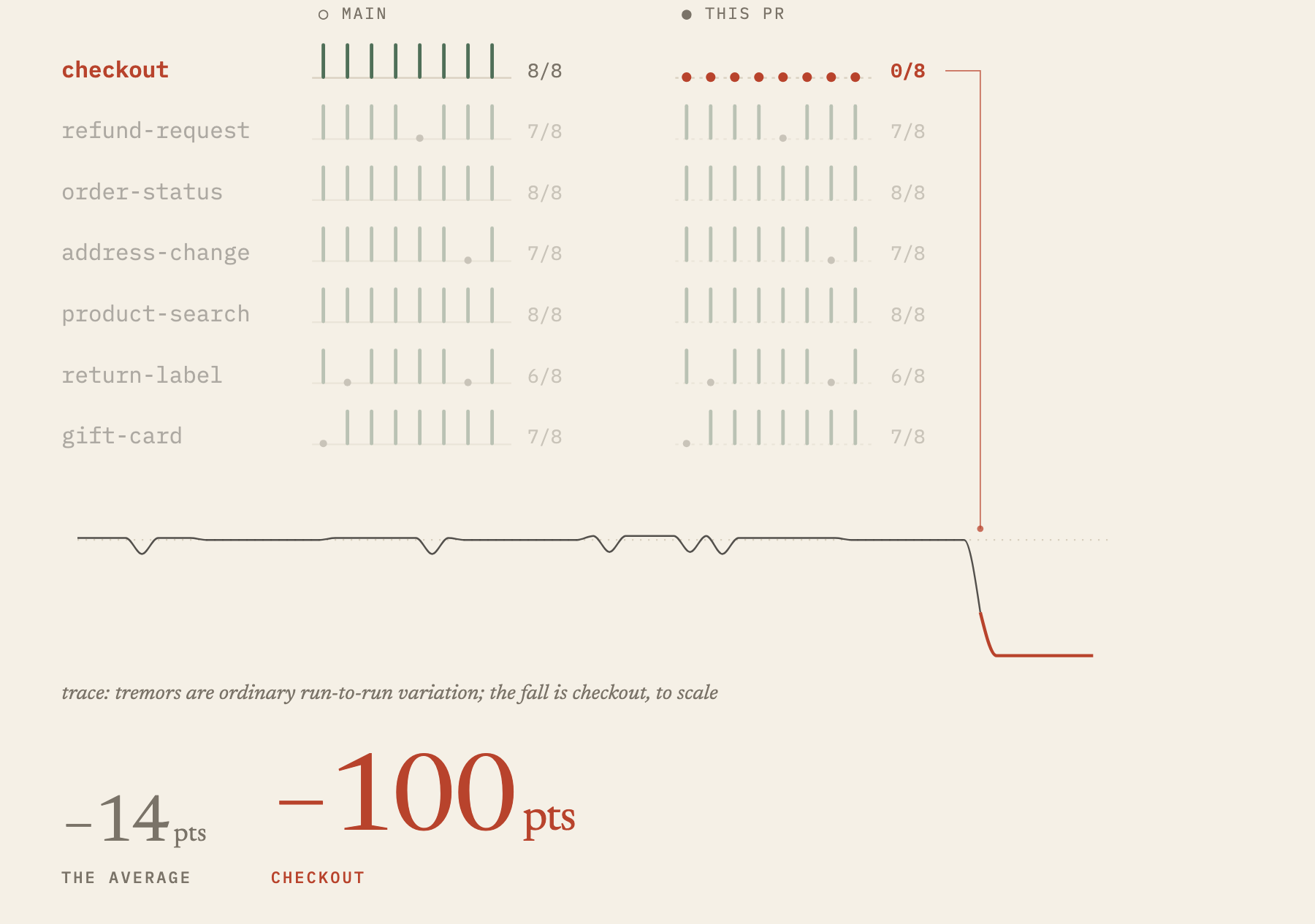
seism demo collapse scenario, where every mark is one run.This isn’t hypothetical for us. The first version of our own check measured only the suite-wide average, and on a real agent it passed a change that cut success from 0.92 to 0.52, with two tasks collapsing. The statistics were computed correctly. They were answering the wrong question. That failure deserves its own post.
3. Sometimes the honest answer is “not enough evidence”
Three tasks, run twice each, going from 100% to 83% is not a regression and not a pass. It is too little data. A binary pass/fail setup has no honest way to represent that, so it gets rounded to whichever side of the threshold it falls on.
Why not just run your eval more times?
Running more repetitions is the obvious fix, and it helps, but it doesn’t answer the question on its own. More numbers still leave four decisions open:
- What counts as independent evidence? Fifty reruns of one task tell you a lot about that task and almost nothing about the others. For a claim about the whole suite, the task is the unit, not the run.
- How big a change matters? A 2-point drop can be real and still not worth blocking a merge over. You have to say how much you care about before looking.
- How do you avoid false alarms across many capabilities? Watch 50 tasks with a simple per-task rule (“block if a task that passed at least 7/8 drops to at most 2/8”) and some healthy PR will eventually trip it by chance. In our simulations of a flaky agent, that rule false-blocks about 1.4% of unchanged PRs at 5 tasks and 13.4% at 50. A rule that corrects for the number of tasks stays under 1% (computation, table C6).
- What do you do when there isn’t enough data? You need a third answer besides pass and fail.
Repeating the eval gives you the evidence. Something still has to turn that evidence into a merge decision.
Turning repeated runs into a merge decision
That is what AgentSeism does. You give it a command that runs your agent on a task and one that checks the result. It runs your base branch and your PR several times each, keeps each task’s results together, and returns one of four verdicts:
| Verdict | Meaning |
|---|---|
| PASS | Neither gate found enough evidence of a material regression. |
| REGRESSION | The suite as a whole is confidently worse by at least your threshold, or a task that reliably worked has collapsed. |
| INSUFFICIENT EVIDENCE | Too little data to decide. It blocks the merge, but it is not reported as a regression. |
| INCOMPARABLE | The model, runtime or dependencies differ between the two sides, so nothing is compared. |
The two gates behind REGRESSION answer different questions, which is why they are separate: did the suite get broadly worse? and did something that used to work stop working? The pull request above is the case where the answers differ.
One correction to the previous note in this series. It ended on “Comparability first. Outcomes decide. Traces explain.” The first two became the product. The third, localising a regression to a stage of the agent’s trajectory, did not, and AgentSeism does not claim it.
How much should you trust it?
We froze the decision rule before testing it, then ran it on seven SWE-bench tasks it had never seen, with a pre-registered protocol: 224 real agent runs, 0 invalid, $38.49 in API cost. It passed an unchanged agent, and it caught both degradations that had been predicted in advance, a capability collapse and a broad collapse.
That evidence is narrow, and it is worth saying how:
- One agent, one model, one kind of regression. All of it is mini-swe-agent with Claude Haiku 4.5, and every degradation was made by cutting the agent’s step budget.
- Moderate regressions are hard to catch. The rule is built to avoid blocking healthy PRs, so a task falling from 100% to 75% usually won’t block a merge.
- It isn’t cheap yet. Eight runs per task on each side is a validation design, not an optimised CI budget.
- No one outside the project has used it yet.
The full protocol and results, including what the study did not establish, are in the repository.
Try it
If your agent’s eval score has ever moved on a PR and you couldn’t tell whether to believe it:
git clone https://github.com/lyr-ai/agentseism.git && cd agentseism
python3.11 -m venv .venv && source .venv/bin/activate
pip install -e .
seism demo
It takes about a second, with no API key and no Docker. Then look at the two public pull requests in agentseism-example: one docs-only change that passes, and the one-line bug above.
Or run your own eval eight times on an unchanged branch, and see how stable it really is.
If this is a problem you have too, a ⭐ on the repo tells me it’s worth continuing. An issue telling me where it breaks on your agent is worth even more.
Written while building AgentSeism. New posts by RSS.