AI companies
When your AI supplier becomes your competitor
Harvey sells AI to lawyers. It’s one of the most valuable application companies built on top of frontier models: in September 2026 it raised $550M at a $15.5B valuation, and its co-founder said it had crossed $400M in annual recurring revenue.
This year, the companies whose models Harvey builds on started selling legal AI too. Anthropic released its first legal plugin at the end of January and expanded it into Claude for Legal in May. In September OpenAI released Astra for Law, a version of its newest model configured for legal work.
So Harvey’s suppliers are becoming its competitors. Yet Harvey’s reported ARR continued to rise sharply. And in the same period, rather than replacing the labs, Harvey has been investing in more of the layer between their models and legal work: benchmarks, post-trained models, workflows, and people inside law firms.
This piece looks at how Harvey got here, where it sits, and what its valuation assumes. The question it ends on is whether owning more of that layer is enough.
How Harvey got here
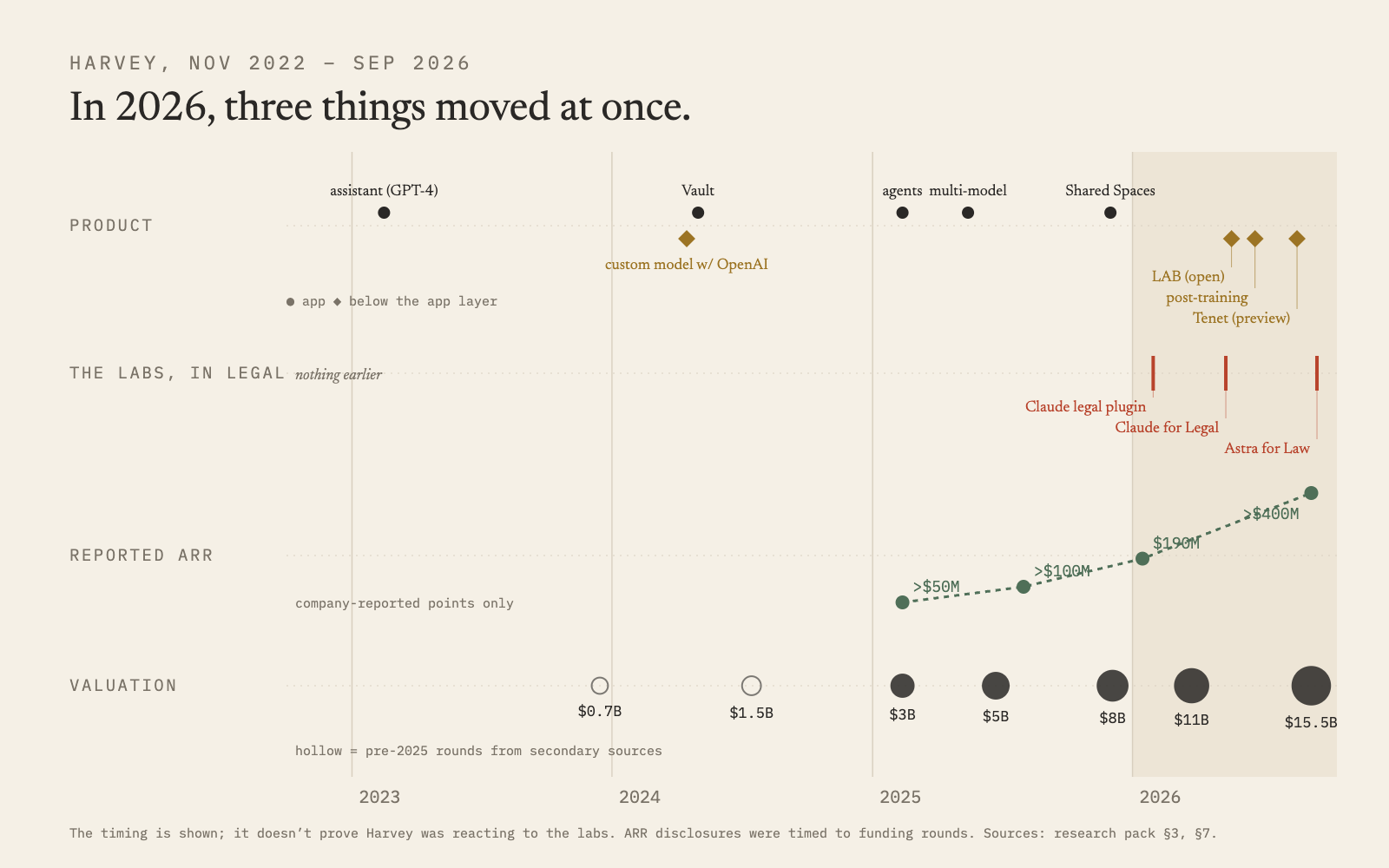
For its first three years, Harvey’s product remained primarily an application layer built on other companies’ foundation models. It started as a legal assistant on GPT-4, added a document store (Vault), then agents and workflows. In 2025 it went from one model provider to several, adding Anthropic’s and Google’s models alongside OpenAI’s.
Its business grew quickly. The company reported more than $50M in ARR in February 2025, more than $100M that August, $190M in January 2026, and more than $400M in September 2026. Each new round was priced higher: $3B, $5B, $8B, $11B and now $15.5B, all within about 19 months.
2026 is where the lanes line up. The labs had no legal products before this year; by September both Anthropic and OpenAI had one. In the same months Harvey did things an application company usually doesn’t:
- it open-sourced a legal benchmark (LAB) in May;
- it ran post-training projects on open-weight models with partners from May to August;
- in August it released Tenet, “our first post-trained open-weight model”, as a research preview.
The timing is striking, but it doesn’t show Harvey was reacting to the labs. Harvey also tends to disclose its ARR around funding rounds, so the business lane is partly what the company chose to announce.
Where Harvey sits
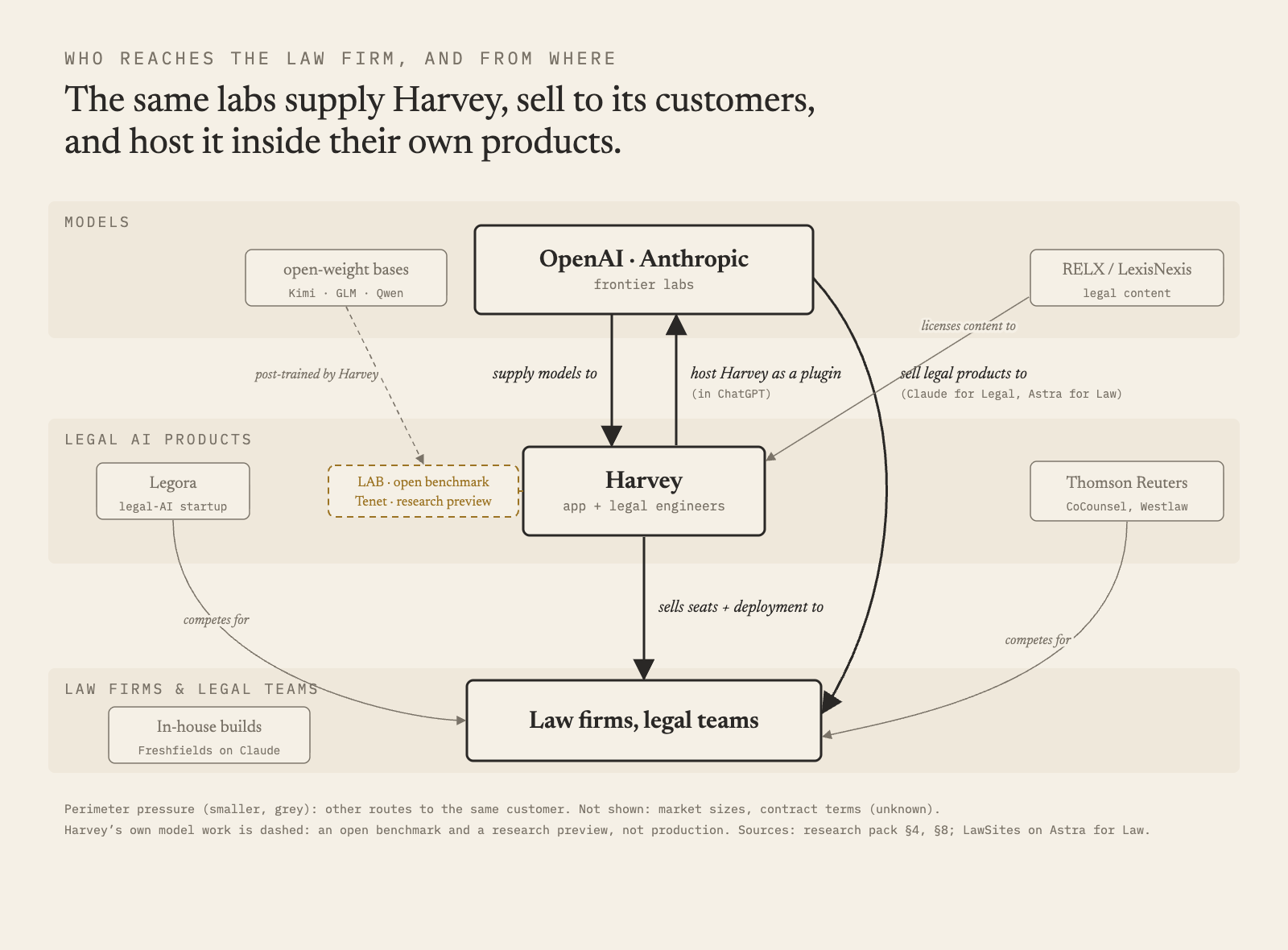
The unusual part isn’t that frontier labs compete with Harvey. It’s that the same companies now stand in three places around it at once.
They supply its models. Harvey’s own benchmark writing describes a version of its Assistant as “built primarily on GPT-5”. OpenAI says Astra for Law will be “available soon to API customers, including Harvey and Legora”. Harvey’s newest capabilities will partly come from the same company that competes with it.
They host it. Alongside Astra, OpenAI launched legal plugins for ChatGPT, “26 from vendors such as Thomson Reuters, Harvey, Legora and iManage”. Harvey is now also something you can reach from inside a lab’s product.
They sell to its customers. Anthropic’s Claude for Legal comes with legal plugins and connectors for specific areas of law. Astra for Law is offered first to selected large firms. Freshfields has deployed Claude across the firm and is co-building legal workflows with Anthropic.
Around that centre, the pressure comes from other directions:
- Legora, another AI-native legal startup, is valued at $5.55B after its spring round, with more than $200M in ARR reported this month.
- Thomson Reuters (CoCounsel, Westlaw) and RELX/LexisNexis own the legal content and the distribution lawyers already pay for. RELX’s LexisNexis also licenses content into Harvey.
- Large firms can build their own. Freshfields is working directly with Anthropic, and Kirkland & Ellis has reportedly committed to its own platform with Palantir.
What Harvey actually owns
Judging by what Harvey sells and where it is hiring, it still looks primarily like an application and deployment company:
- Customers. The co-founder says Harvey has more than 3,000 customers, including 80% of the top 100 US law firms, 20% of the Fortune 500 and half of the Fortune 10. How many of those are firm-wide deployments isn’t disclosed.
- Workflow product. Assistant, Vault, agents and collaboration features. That’s the part lawyers use every day.
- People inside firms. Of 304 open roles on its job board, 33 are for legal engineers, people who deploy Harvey into a firm’s work. About six or seven are for research or model training.
Below the app, it owns less than the headlines suggest. It hasn’t pre-trained a model. Its post-trained models start from other companies’ open weights (Moonshot’s Kimi, Zhipu’s GLM, Alibaba’s Qwen) and are trained with partners. Tenet is a research preview, and nothing public shows it serving production traffic. Its benchmark is open, and its gains are measured on that benchmark.
Harvey does give reasons for going down the stack. On its own benchmark, “reaching the top of the closed-source leaderboard runs to roughly $50 per task and over 20 minutes of latency”, and frontier models complete “less than 10% of tasks end-to-end”. Open-weight models “can be hosted within a firm’s own secure cloud environment”. After the latest round, its co-founder said the company would invest “heavily in both its harness and its own model training”.
So the honest description today is an application company with a growing bet below the application layer. The bet is not yet a business.
What investors are pricing in
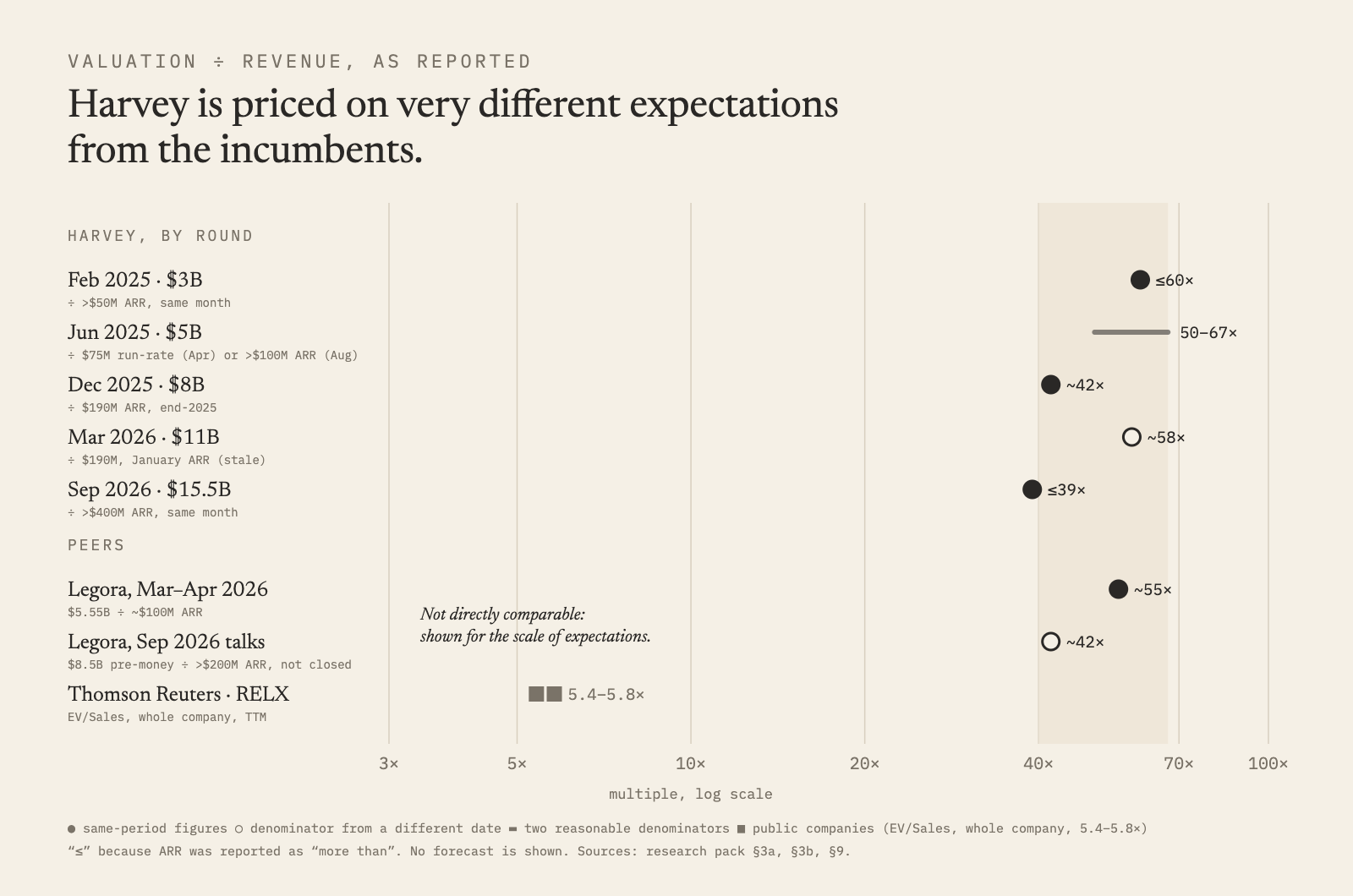
At $15.5B and more than $400M in ARR, Harvey is valued at no more than about 39 times its recurring revenue. That’s lower than at its earlier rounds, because reported ARR grew faster than the valuation, but it’s still far from the incumbents. Thomson Reuters and RELX trade at roughly 5–6 times their sales. Legora sits in the same range as Harvey.
These numbers measure different things (a private round’s valuation against reported ARR, against a public company’s enterprise value over a year of total revenue), so the comparison isn’t precise. What it shows is scale: the multiples imply expectations very different from those attached to mature legal-information businesses.
That leads to the useful question. It isn’t “is Harvey worth $15.5B?” but what has to become true for Harvey to grow into these expectations?
Three paths
The evidence supports three plausible directions. None of them is decided, because the numbers that would decide them (margins, retention, and whether Harvey’s own models carry real traffic) aren’t public.
1. A vertical intelligence layer. Harvey’s own benchmark, models and data become the reason firms stay.
- Must become true: its own models serve a meaningful share of production work, and that shows up as better margins or prices; firms pay for firm-specific models.
- Breaks it: the next frontier generation beats post-trained open models at similar cost, or firms post-train their own.
2. The deployment platform on other people’s models. Harvey stays model-agnostic and wins on workflow, integration and the people it puts inside firms.
- Must become true: retention and expansion hold as the labs sell direct, and deployment depth grows faster than the labs’ own legal offerings.
- Breaks it: firms standardise on a lab plus an internal platform, as Freshfields is doing with Anthropic, or usage pricing compresses revenue per seat.
3. Beyond law. Harvey becomes a platform for professional services more broadly. It has bought an asset-management platform and says it works with 125+ asset managers.
- Must become true: non-legal revenue becomes a material, disclosed share.
- Breaks it: incumbents or the labs own those workflows first. The evidence here is mostly announcements.
What limits every path
- The technology isn’t done. On Harvey’s own benchmark, frontier models complete less than 10% of long tasks end to end, and Tenet improves on its base model without getting close.
- The labs move up. Their legal products, and their models inside competitors’ products, reduce what an application layer adds.
- The incumbents move down. Thomson Reuters and RELX have the content and the contracts lawyers already rely on.
- Customers can build. The largest firms have the money and, increasingly, the partners to do it themselves.
The open question
We know Harvey has built distribution and revenue quickly. We know it’s experimenting below the application layer. We don’t yet know whether owning more of the model stack is necessary for its business, or even valuable to it.
The open question isn’t whether Harvey can build a legal model. It’s whether owning more of the intelligence layer makes the company harder to replace than simply owning the customer relationship.
What we know
| Evidence level | Claim |
|---|---|
| Observed | The labs launched legal products in 2026; OpenAI’s legal launch includes Harvey both as an API customer and as a ChatGPT plugin; Harvey released an open benchmark and a post-trained model in research preview; far more of its open roles are for legal engineers than for model research |
| Reported | $15.5B valuation; more than $400M ARR and 3,000+ customers (company); earlier ARR points and round valuations; competitors’ valuations and ARR |
| Inferred | Harvey is hedging below the application layer rather than replacing its suppliers; the valuation prices in growth very unlike an incumbent’s |
| Unknown | Margins, retention, how much work runs on Harvey’s own models, what “customer” counts, contract terms with the labs and LexisNexis |
Sources: Anthropic’s public knowledge-work-plugins repository (the legal plugin is in its first commit, 2026-01-29); Harvey’s blog (the Tenet research preview; post-training with Baseten; BigLaw Bench Arena); LawSites on the September 2026 round and on Astra for Law; TechCrunch and PointBlank on Claude for Legal; Freshfields on its Anthropic partnership; Harvey’s job board (Ashby, read 2026-09-28); public-market multiples as of 2026-09-27. Revenue figures are company-reported unless marked; where sources disagree, the research traced each figure to its date and definition rather than picking one.
Written while building AgentSeism. New posts by RSS.