Systems, Seen · No. 2
The engine kept moving underneath Ollama
Should a project build its own inference engine, or rely on an upstream one?
Ollama’s git history gives an unexpected answer: both.
Over three years, Ollama moved from borrowing llama.cpp, to copying it into its own repository, to building its own GGML-based engine. Then, in May 2026, it deleted that engine and handed GGUF models to upstream llama.cpp’s server.
That sounds like a reversal. It wasn’t quite.
At the same time, Ollama was building another engine of its own, on Apple’s MLX, and it kept that one. By September 2026 the stack had split:
- GGUF models → upstream llama.cpp. Ollama borrows it.
- safetensors models → Ollama’s MLX engine. Ollama builds it.
The interesting decision wasn’t build or borrow. It was where to own the engine.
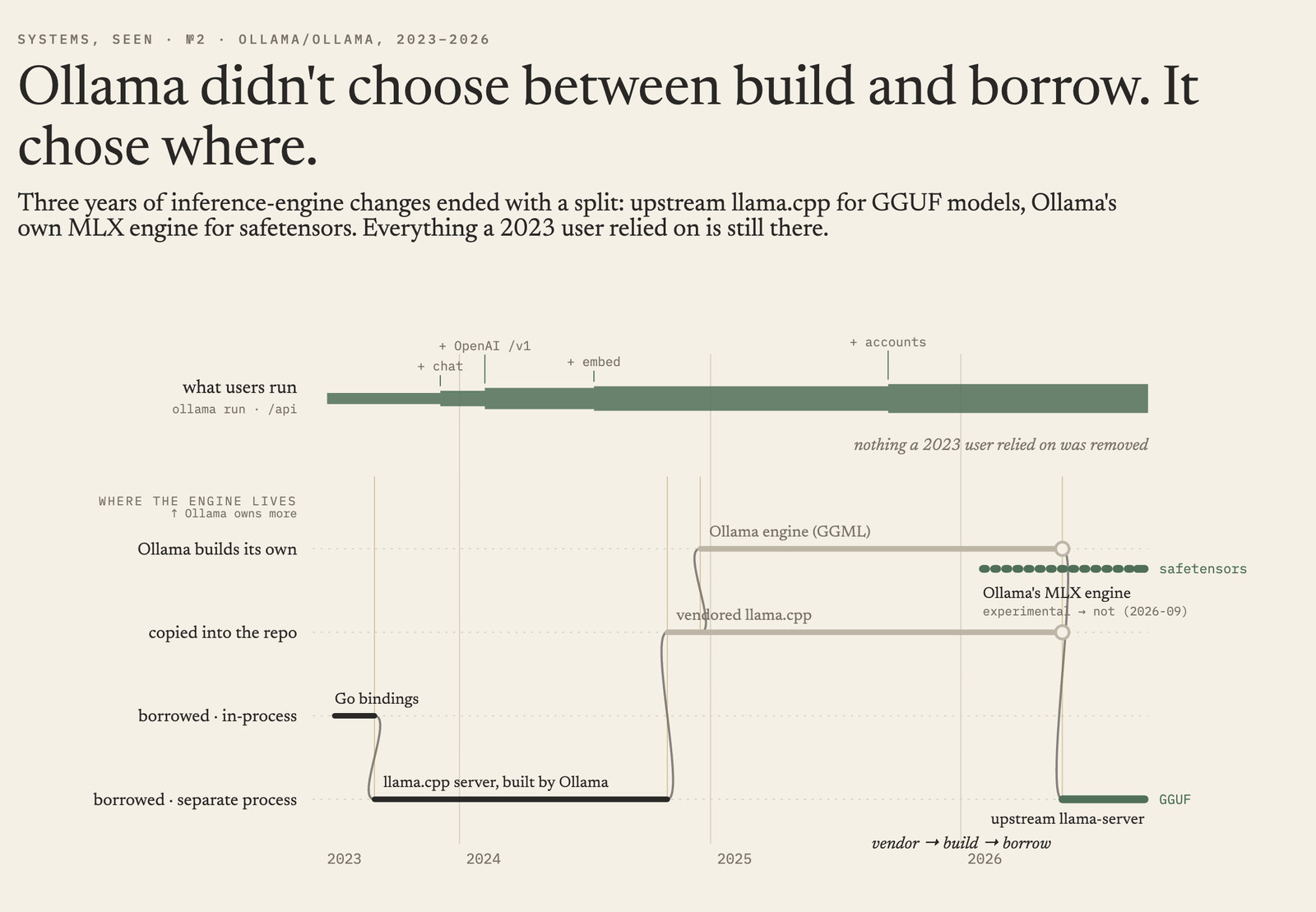
What makes this easy to miss is that users never had to notice: every command and API endpoint a 2023 user had is still there. I read Ollama’s full git history (5,796 commits, June 2023 to late September 2026) to see what happened underneath.
What users saw
The surface only grew. ollama run MODEL and the eight original endpoints
(/api/generate, /api/pull, /api/tags and the rest) exist at every point I
checked, including today. On top of them came /api/chat (December 2023), an
OpenAI-compatible API (February 2024), /api/embed (July 2024) and account endpoints
(September 2025).
Nothing a 2023 user relied on was removed. From the perspective of that original surface, Ollama remained compatible while adding more.
What moved underneath
The engine is a different story. Reading the tree and the commit messages, it went through these places:
- July 2023: Go bindings. Ollama called llama.cpp in-process (“add llama.cpp go bindings”).
- August 2023: llama.cpp’s server, as a separate process. “subprocess llama.cpp server” removed the C code; Ollama now ran llama.cpp’s own server and talked to it. From January 2024 it carried its own patches on top.
- October 2024 (v0.4.0): llama.cpp copied into the repo. “Remove submodule and shift to Go server”: llama.cpp was vendored, and driven by a Go server.
- December 2024 onwards: Ollama’s own engine. “Runner for Ollama engine”, then a GGML-based backend and model implementations written in Go, running alongside the vendored llama.cpp.
Plotted by how much of the engine Ollama owned, that’s a steady climb: from borrowing llama.cpp, to copying it in, to building its own.
It looks like build, then borrow
Then, on 29 May 2026, one commit reversed most of it:
Remove the vendored GGML and llama.cpp backend, CGO runner, Go model implementations, and sample. llama-server (built from upstream llama.cpp via FetchContent) is now the sole inference engine for GGUF-based models.
The engine Ollama had built for GGUF models was deleted. So was the copied llama.cpp. Ollama went back to running llama.cpp’s server as a separate program, this time upstream’s own, built at build time, with a small compatibility layer so it can load Ollama-format model files.
It is tempting to read that as a verdict: they tried to build their own engine, and it didn’t work out.
That’s the wrong conclusion
The same commit carries a parenthesis:
(Safetensor based models continue to run on the new MLX engine.)
Ollama had been building a second engine of its own, on Apple’s MLX, since February
- About three and a half months after the GGUF engine was removed, the MLX one was promoted: “the only Go inference runner left and is no longer experimental.”
So in 2026 Ollama didn’t stop building. It split:
| Model format | Engine | Ollama’s relationship to it |
|---|---|---|
| GGUF | upstream llama.cpp server | borrows it |
| safetensors | Ollama’s MLX engine | builds it |
The decision wasn’t build or borrow
“Build or buy” is usually framed as one decision for a whole component. Ollama’s history shows it made twice, and the second time it wasn’t made for the whole component at all. The line ended up being drawn by model format: GGUF moved to upstream llama.cpp, while safetensors stayed on Ollama’s own MLX engine.
The more useful question isn’t “should we build our own engine?” It’s “where should we own the engine?”
The only reason the maintainers give is in that commit: “This allows us to more rapidly pick up new capabilities and fixes from llama.cpp as they come out.”
What this doesn’t tell us
Everything above comes from the repository itself: the file tree at different dates, and the commit messages. So there is a lot it can’t say:
- whether the switches made Ollama faster or slower, or changed anything users noticed;
- what the in-house GGML engine cost to maintain, and why exactly it was dropped, beyond the one sentence above;
- how the team made these decisions;
- whether the MLX engine will one day go the same way.
Commit messages are the maintainers’ own framing. I’ve quoted them, and checked each phase against the tree, but I haven’t filled the gaps with guesses.
What the history does show is a pattern worth recognising in any system you depend on: a surface that never broke, over an implementation boundary that kept moving.
Method: a full clone of github.com/ollama/ollama (HEAD 16b4376a, 2026-09-26), read
from the raw history; no third-party summaries. Engine phases: 6093a88c, 42998d79,
b754f5a6, ed443a03, dcfb7a10, d8cc798c, 9db4bdba, 2e036e7c. Surface
additions: 7a0899d6 (/api/chat), 453f572f (/v1), b9f5e16c (/api/embed),
8b894933 (accounts).
Written while building AgentSeism. New posts by RSS.