Agent runtime · Field note 02
Restoring the code is not resuming the agent
What agent replay taught me about durable execution.
While building replay support for AgentSeism, I tried to resume two coding-agent executions from exactly the same repository state. The source fingerprint matched byte for byte. The executions did not.
One carried a different scratch file. Their message histories were different. Restoring the repository gave me a state that looked correct according to my instrumentation, but it was not the same agent execution.
That failure changed how I think about long-running agents. Once an agent executes tools, modifies an environment, accumulates context, and runs for minutes or hours — on one fixed task I measured runs from three minutes to over six hours — recovery stops looking like “reload the prompt and workspace” and starts looking like a distributed-systems problem.
I had started with a simple question: “How do I save the workspace?” The experiment forced a harder one: “What does it actually mean to resume an agent?” Following it led quickly into checkpoint consistency, execution ownership, fencing, idempotency, replay semantics, and external side effects.
1. Repository state is only part of agent state
For a coding agent, the repository is an obvious piece of execution state and one of the easiest pieces to measure objectively. In AgentSeism, tracked source state is represented using a canonical Git diff, so two executions can be compared without interpreting model reasoning.
That is what made the pair in the opening measurable in the first place: the same canonical diff, byte for byte. Everything the diff does not cover — scratch files, message history — was different. The source code was identical; the complete execution state was not.

The repository is therefore one component of agent state rather than the agent state itself. Restoring repository state is not the same as resuming the agent execution.
Restore the transcript and the tracked source but drop the scratch files, and
you get an agent whose memory contradicts what it can see: it remembers writing
repro.py, reads it back, and is told the file does not exist. What follows is
not a resumed job. It is a confused one.
2. A checkpoint is a recoverable boundary
A more useful definition is: a checkpoint is a recoverable boundary in the execution state machine.
For a long-running coding agent, that boundary may include conversation context, tracked and untracked workspace, tool state, execution step, remaining token/time/cost budgets, model configuration, and progress of externally visible operations. The exact schema is application-dependent. The important property is that the runtime can give a precise meaning to recovery from that checkpoint.
Restarting a fresh agent from an old Git diff may be useful, but it is a restart from source state, not a resume of the original execution. The two are different products, and a runtime should say which one it offers.
3. Partial checkpoints are more dangerous than missing checkpoints
Suppose an agent begins creating a checkpoint at step 100. Messages and workspace are stored, but the worker crashes before tool state is durable. Restoring the pieces that happen to exist would create a mixed state that never existed in the original execution.
This is worse than having no checkpoint at all, because it looks legitimate. A missing checkpoint costs work; a half-written one costs trust, and the failure surfaces much later as agent behaviour nobody can explain.
A safer design writes checkpoint components as immutable objects first and publishes a small manifest only after every required component is durable.

Recovery recognizes only a committed manifest. Partially uploaded objects are harmless orphans until garbage collection or later deduplication. The goal is to make invalid mixed states impossible to express, rather than merely detectable after the fact.
This is not two-phase commit. It is the much cheaper pattern — data first, pointer last — that Git uses for objects and refs, and that filesystem journals and object-store table formats use for the same reason: make the only mutable thing a single small atomic write.
4. Immutable data and execution authority are different problems
Suppose Worker A owns an execution under generation 7. A network partition causes its lease to expire, and Worker B takes ownership under generation 8. Worker A may still be alive.
If A finishes uploading an immutable, content-addressed workspace blob, little harm occurs. What A must not be allowed to do is declare a new recovery point after it has lost ownership.
This leads to a useful principle: separate immutable data-plane writes from ownership-sensitive metadata publication. Blob writes can be independent; publishing a checkpoint manifest or advancing the recovery pointer requires the current fencing generation.
5. The architecture naturally splits into a control plane and a data plane
As the recovery requirements accumulated, the control-plane/data-plane boundary became the architectural abstraction I found most useful.
The control plane owns execution intent and authority: job lifecycle, scheduling, leases, fencing generations, recovery lineage, quota, policy, and checkpoint publication authority.
The data plane performs the work: workers, sandboxes, the agent loop, model and tool calls, workspace mutation, immutable checkpoint production, and trace emission.
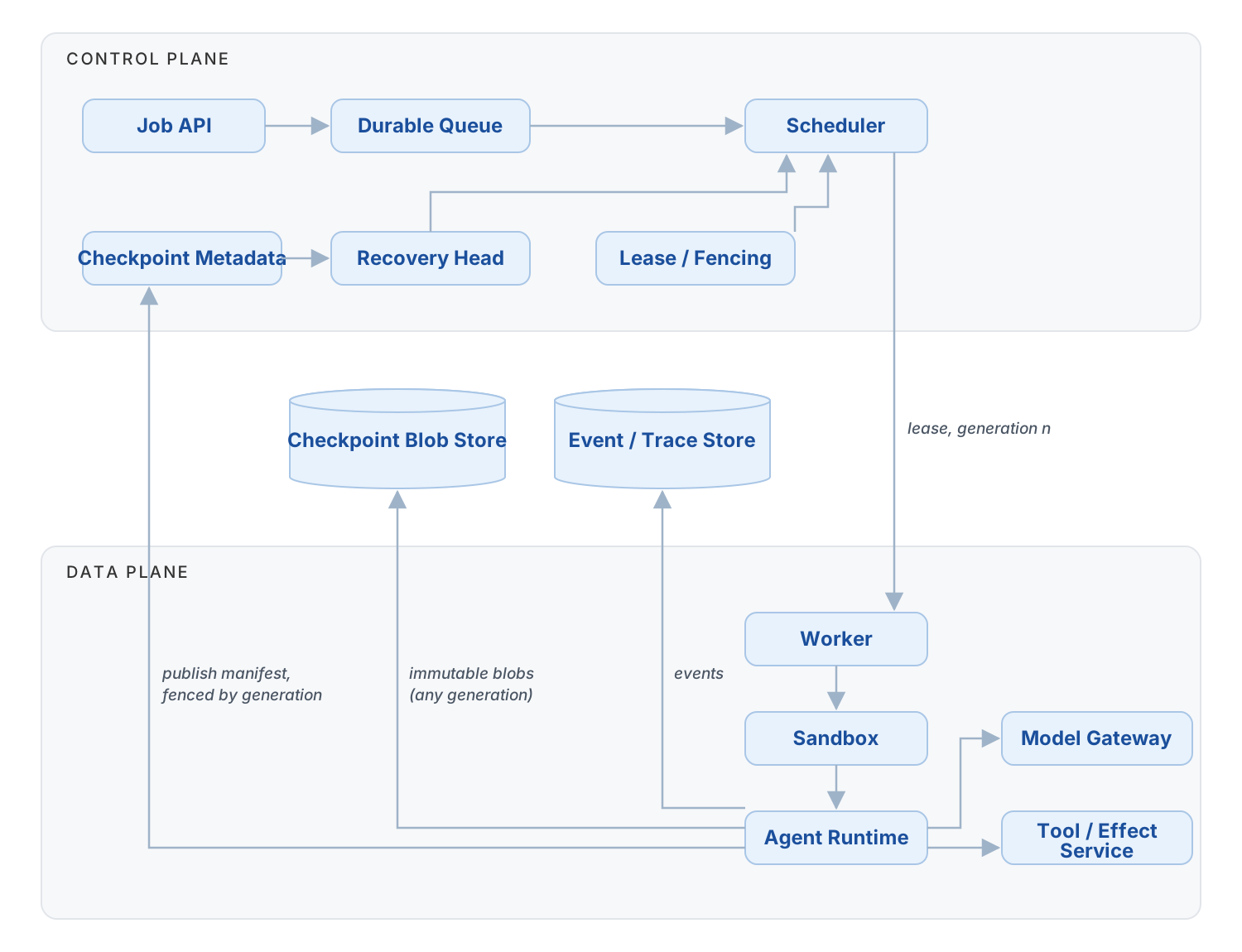
Two edges cross the boundary upward, and they are different in kind. The blob write is unconditional: content-addressed, immutable, harmless from any generation. The manifest publish is a request that the control plane may refuse, and refuses whenever the generation is stale.
The distinction is not merely organizational. The data plane is where risky and failure-prone execution happens. A buggy agent or crashed worker should not be able to redefine execution ownership or declare an arbitrary checkpoint authoritative.
The data plane may produce candidate state; the control plane decides which state is authoritative.
6. Lease, fencing, and recovery preserve authority
A lease defines time-bounded execution ownership, but it cannot prove that an old worker has stopped. During a network partition, a stale worker may continue running even after the control plane has reassigned the job. For a while, two workers are physically executing the same job.
Fencing therefore protects ownership-sensitive writes. Each assignment receives a monotonically increasing generation, and durable services reject mutations from stale generations. The store does the rejecting, not the worker, because a partitioned worker cannot be trusted to know it has been fenced.
Worker-side self-termination is still useful because it reduces wasted computation, but it is not the correctness boundary. Self-fencing is an optimization; server-side fencing is the correctness boundary.
The four mechanisms solve different problems, and each catches what the one above it cannot:
| mechanism | catches | cannot catch |
|---|---|---|
| lease | a dead worker | a live, partitioned one |
| fencing | its writes to our stores | what it already sent outside |
| idempotency | duplicate external effects | providers that cannot deduplicate |
| self-fencing | continued waste | anything, as a correctness claim |
The bottom row is the trap: self-fencing is the only one of the four that is not a correctness mechanism, and it is the one that looks most like a fix.
7. “Latest” is not one thing
Suppose an agent reaches step 120 but its newest durable checkpoint is step
- The worker crashes, and a replacement resumes from step 100 under a higher generation. Ownership moved forward while logical execution progress moved backward. Both statements are correct, and a design with one sequence number has to lie about one of them.
A runtime should therefore distinguish three orderings, and use each for what it is for:
- generation — who owns execution now. Strictly monotonic. Recovery selection uses this first.
- checkpoint sequence — which checkpoint within this attempt. Monotonic within a generation. Recovery selection uses this second.
- agent step — how far this branch has got. Not monotonic across recovery. Billing and budgets use it; recovery selection never does.
Choosing a recovery point by agent step is how a stale branch gets adopted
because it happened to get further. I prefer recovery_head over
latest_checkpoint: it means the newest durable recovery point on the
currently authoritative execution lineage, not the largest historical step
number.
The user-facing consequence is small but real: a progress indicator derived
from the recovery head goes 120 → 100 after a recovery, which reads as data
loss for a system that behaved correctly. Report the high-water mark and the
current branch position as two numbers, and do not invent a percentage — an
agent’s step count is not distance-to-completion.
8. Checkpointing does not make external effects transactional
The control plane can protect state it owns. The external world is harder.
Suppose an agent checkpoints, calls send_email(), the provider accepts the
email, and the worker crashes before recording success. A replacement restores
the previous checkpoint. The runtime cannot know whether retrying will
duplicate the message.
No better workspace snapshot removes this ambiguity. A durable runtime therefore needs a separate effect protocol: write-ahead intent, durable logical operation identity, effect execution, result commitment, and reconciliation when the outcome is uncertain.
The write-ahead intent is what turns an unknown into a known unknown. On
recovery, pending means this may or may not have happened — not a solution,
but the precondition for every one that follows. The cheapest discharge is
often to trade readability for idempotency: embed the operation id in the
message itself, and on recovery search the provider’s sent items before
deciding whether to send. Where no read path exists, the tool declares whether
it prefers at-least-once or at-most-once, and for the latter the platform parks
the job for a human rather than guessing.
Checkpointing recovers computation state; it does not make external side effects transactional.
9. Recovery and replay can want different observations
Read-only tools avoid duplicate effects but introduce another problem. Suppose an expensive search returns observation O1 after the last checkpoint, and the worker later crashes. Re-running the search may cost money and may now return O2.
Replay asks, “What did the agent observe then?” and usually wants O1. Recovery asks, “What should the live job observe now?” and may prefer O2.
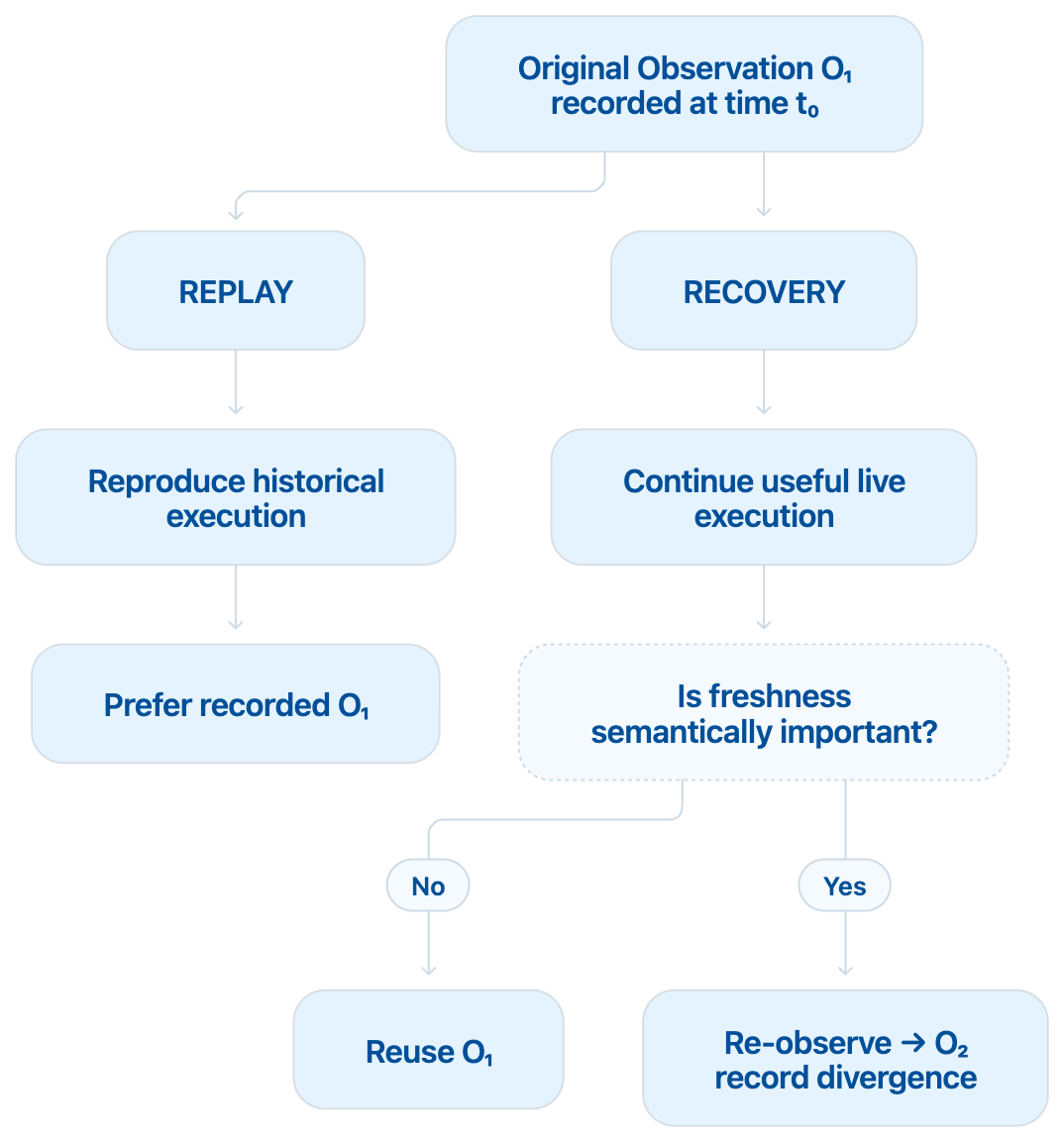
For expensive observations, persistence can be decoupled from checkpoint cadence: record the result at the moment of the call, keyed by its semantic input, so that a crash does not force a high checkpoint frequency on a system that did not otherwise need one. Semantic cache identity must include all result-changing context, including tool version, canonical arguments, repository revision, and tenant or authorization scope. Omitting authorization scope can turn a performance optimization into a cross-tenant data leak.
Retention is also part of the contract. Recovery-critical payloads cannot be sampled away while recovery promises to use them. Observability payloads may use sampling or tiered retention. Digests can be kept broadly to detect that an observation changed even when the payload is no longer available.
If recovery is expected to provide a payload, its retention period is a correctness property, not merely a storage optimization.
10. Resume is a continuation, not a replay
Everything above restores the starting point. None of it restores the future, because the next model call is a fresh sample from a system that is not deterministic.
I measured this directly. Forking continuations from an identically reconstructed state — same tracked source, same scratch files, same transcript, temperature 0:
14 of 16 continuations reproduced the donor's next three actions exactly
 0 of 15 reached the donor's final state
Short-horizon behaviour is near-deterministic; long-horizon behaviour is not. The checkpoint guarantees the agent restarts from the same state, not that it does the same thing.
The same applies to a retried model call. A response lost in transit and re-requested is a new sample, not a repeat — even at temperature 0 the serving stack does not reproduce itself, and in one batch of 333 model calls, 12 were sampled more than once because of transport failures alone, one of them six times. A silent retry does not redo the same work slightly wastefully; it branches the trajectory, and the trajectory has to record that it did.
Two consequences follow. Idempotency keys cannot be derived from trajectory position, because the resumed trajectory diverges from the original. And if a product genuinely needs replay — audit, regression testing — it needs recorded outputs, every tool result and every model response, replayed from the log instead of re-executed. Replay from recorded outputs, yes; reproduce by re-execution, no.
11. Long-running agents start looking like durable workflows
A short agent can often be retried from the beginning. A two-hour agent cannot. As runtime increases, so does accumulated context, completed tool work, modified environment state, external effects, and compute already invested. The probability of an infrastructure failure during the run also increases.
At that point, durability stops being optional. The system begins to resemble a durable distributed workflow: a job has an owner, runs in an isolated worker, advances an agent state machine, produces checkpoints and effects, and may transfer ownership after failure.
This is why I expect agent infrastructure to borrow increasingly from workflow engines, distributed schedulers, transactional systems, and sandboxed compute platforms rather than only from model-serving APIs.
12. What I would build next
AgentSeism’s current replay and fork infrastructure is experimental rather than a production runtime. Its purpose is to reconstruct execution states precisely enough to study agent variation and intervention. But the work suggests a concrete production direction.
I would make the control-plane/data-plane boundary explicit; make checkpoints crash-consistent through immutable objects and atomic manifest publication; route consequential external operations through a guarded effect service; separate live recovery semantics from deterministic replay; and add stronger sandbox isolation plus a shared inference layer.
I would then test the design with deliberate failure injection: worker crashes, network partitions, stale owners, interrupted checkpoint publication, model timeouts, and ambiguous tool effects.
The key metric would not be whether a resumed agent follows exactly the same future trajectory. Section 10 says it will not. The stronger durability question is whether the system can resume from a well-defined state without corrupting execution, duplicating consequential effects, or losing information required for correctness.
Conclusion
I started with what looked like a small implementation task: reconstruct an agent at a previous step so I could replay and fork its execution. The first surprise was that restoring the repository was not enough.
Following that observation led naturally into checkpoint consistency, execution ownership, fencing, idempotency, observation persistence, and recovery semantics. None of these problems are unique to AI, but agents combine them in an unusual way because they mix long-running computation, stochastic model calls, mutable environments, and potentially irreversible tools.
The mental model I now use is simple:
An agent checkpoint is not a saved workspace. It is a durable boundary in an execution state machine.
Once an agent becomes long-running enough to deserve recovery, that distinction matters.
Written while building AgentSeism. New posts by RSS.