Agent memory · Note 02
Memory is not a list of facts
What building long-term memory for agents taught me about state.
When I started building long-term memory for agents, I thought the hard problem was retrieval. Store memories, embed them, retrieve the relevant ones, rank them well enough that the agent sees the right context.
That model works — until memory starts changing.
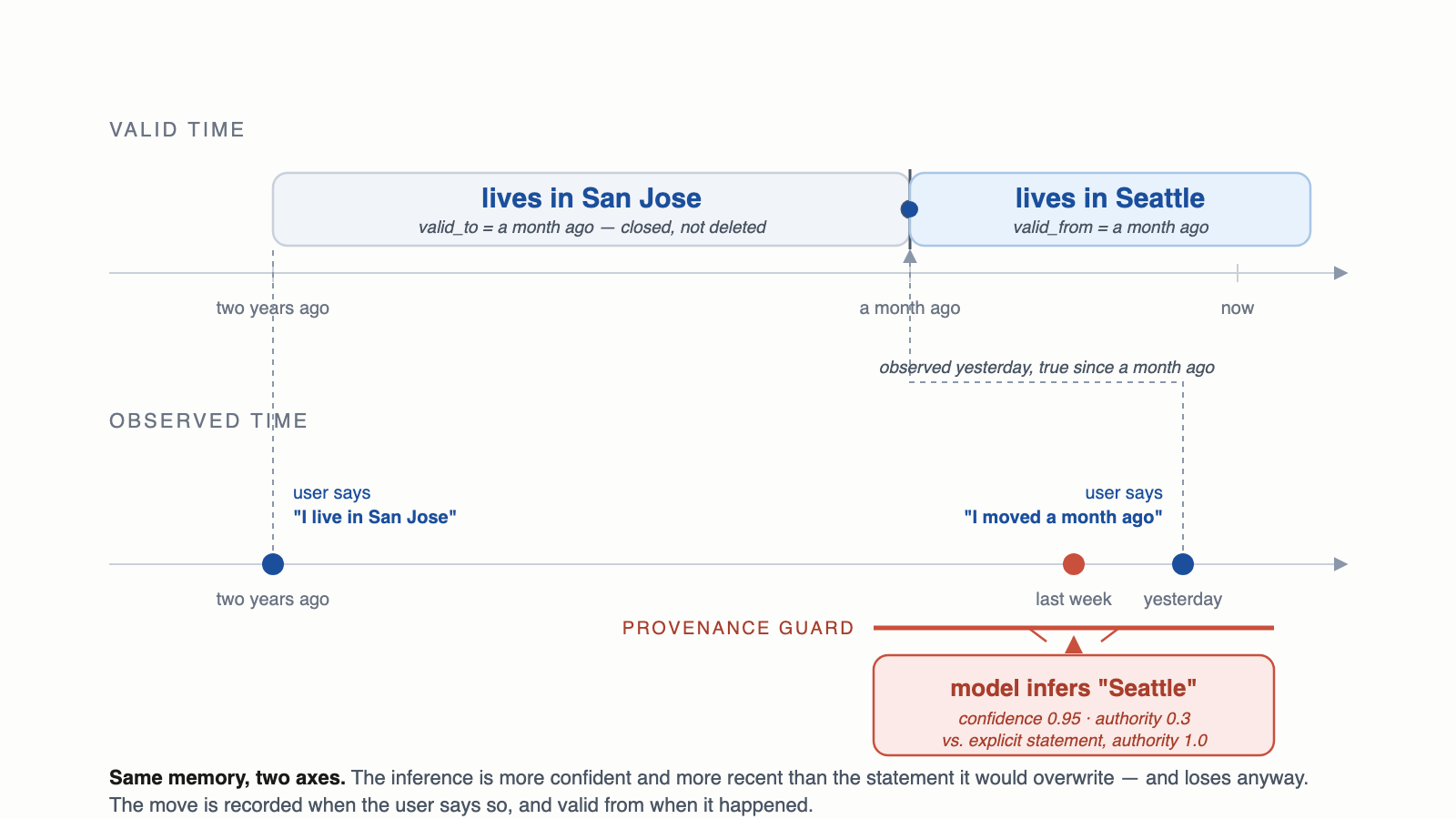
Two years ago, a user said: “I live in San Jose.” Last week, the model inferred from a conversation: “The user lives in Seattle.” Which one should the system believe?
At first this looks like a retrieval question: retrieve both, let the model decide. But the moment an agent is expected to hold persistent state across months, it stops being about retrieval. It is a state-management problem, and it comes with the questions state-management problems always come with. Who is allowed to change this? When was it true, as opposed to when did we learn it? Can we reconstruct how we got here? Does every kind of state change the same way?
I ran into each of those while building TypedMem. Here is what each one changed.
1. Confidence is not authority
The San Jose memory came from an explicit user statement. The Seattle memory came from a model inference, with high confidence, made last week.
A policy that ranks by recency and confidence prefers Seattle. That is uncomfortable, and the discomfort is the point: the two memories differ on a dimension neither recency nor confidence measures.
Confidence answers how sure are we about this claim. Authority answers how entitled is this source to override another. An explicit statement from the user and an inference by the model are not interchangeable evidence, however sure the model is.
So authority became its own guard: a memory with weaker provenance cannot replace one with stronger provenance. Not folded into confidence, not weighted into a score — checked first, on its own.
The reverse is deliberately not true. Higher authority does not automatically win. An old high-authority statement should not overwrite a newer state just because its source is stronger; the user may well have moved. Authority is a veto for the weaker side, not a trump card for the stronger one.
The tempting alternative was a single number:
score = a·authority + b·confidence + c·recency
It is attractive because it produces one ordering. It also destroys the meaning of each term. Authority, confidence and time are different kinds of evidence, and a conflict rule that keeps them separate is slightly more explicit and much easier to reason about — you can say why a memory lost.
2. Observation time is not validity time
The original schema had one timestamp, and it was quietly doing three jobs: when the memory was observed, when its content became true, and where confidence decay starts. Those coincide often enough that one field seems fine.
Then: yesterday, the user says “I moved to Seattle a month ago.”
There are two times now. The memory was observed yesterday; its content has been true for a month. And the previous state has a natural end: San Jose stopped being true a month ago, not yesterday.
So a memory carries a validity window, half-open — [valid_from, valid_to) —
separate from the observation time. Half-open so that when one state ends and
the next begins at the same instant, exactly one of them is valid.
Two consequences I did not anticipate.
Future state becomes expressible. “Starting October 1, I’ll be using Postgres” is observed today and valid later. Which forces a rule: filter by validity first, then pick the latest — otherwise a declared future state shadows the current one merely because its start is later.
“Unspecified” has to stay unspecified. For old data with no validity
window, the observation time is the operational fallback. But the storage
keeps the distinction: a missing valid_from means the writer did not say,
not the writer said it starts at observation. That sounds pedantic until
you need to replay history and cannot tell which memories were declared and
which were defaulted.
3. History is not replay
The system already had an event log. A replacement produced an event saying one memory replaced another, with the new version number and a fragment of the old content. Good for auditing. Useless for reconstruction.
The gap is between what happened and what the state was. Knowing that memory 42 was replaced at version 3 does not tell you what memory 42 looked like before, or exactly what it became. A log of events is a history of actions; it is not a history of state.
The fix was less clever than I expected. Every state-changing event now carries the full logical state of the memory before and after. Not a diff — the whole thing, twice. Creation has no before; deletion has no after.
That costs storage, and it makes replay boring: walk the events in order, keep the after. No patch language, no dependency on an earlier snapshot, no ambiguity about nested structure. Boring is the property I wanted.
One rule matters more than the format:
Replay must not re-run conflict resolution.
Suppose the conflict policy changes six months from now. If replay feeds the historical inputs through today’s policy, the reconstructed past differs from the past the system actually produced. Replay restores decisions; it does not reconsider them. The same log, under any current policy, replays to the same historical state.
That distinction — restore what was decided versus re-decide from the inputs — turned out to be the same one I keep meeting in agent runtimes: replaying a recorded execution and re-executing it are different products, and a system that blurs them is wrong about both.
4. There may be no universal rule for who wins
Once authority and validity were explicit, one more hard-coded assumption became visible. Under replacement, an incoming memory had to be no weaker than the existing one on both validity start and confidence.
The tempting abstraction was a lexicographic ordering: compare validity start first, then confidence as a tie-breaker. It is a natural thing to write, and it quietly changes the semantics. Timestamps rarely tie, so confidence would almost never be consulted. A newer memory with confidence 0.5 would replace a day-old one with confidence 0.9. That is newest wins with extra steps.
What the rule actually was — and what I kept — is a conjunctive guard: to replace, the incoming memory must be no weaker on every listed dimension. Newer and stronger replaces; newer but weaker is ignored; older is ignored. The order of the dimensions does not matter, because nothing is being broken in sequence — every one is checked.
And then the question that made this a per-type decision: should every kind of memory use the same guard? A deadline may care primarily about the latest effective state. A biographical fact may require both recency and confidence. Other memory types will make different trade-offs. These are different kinds of state, and there is no reason they share update semantics. So which dimensions guard replacement is declared by the memory type.
With one exception. In TypedMem, authority stays outside that list: a type may choose which temporal and confidence signals guard replacement, but it cannot silently disable provenance protection. Letting a configuration quietly turn off a safety invariant would turn the first lesson back into a suggestion.
What changed in my mental model
None of these are four features. They are consequences of one decision: treating memory as state rather than as a collection of documents.
retrieval asks       what is relevant to this query?
memory-as-state asks what do I currently believe, why, since when,
                     who was allowed to change it, and can I reconstruct
                     how I got here?
The system has more concepts now than it did — authority, validity, before and after, per-type guards. On paper that is more machinery. But the underlying problems existed before the concepts did. A single timestamp did not remove temporal semantics; it forced three kinds of time into one field. Ignoring authority did not remove provenance; it let confidence make decisions it was never designed to make. An audit log without state did not remove the need for replay; it made replay impossible. The distinction that matters is not simple versus complex. It is essential versus accidental complexity, and the test is whether each concept means exactly one thing.
What I deliberately did not build
Automatic closing of the previous validity window. Ranking by authority. Compaction and checkpoints for the event log. Migrating history under a new policy. Rebuilding a store from its log. A general rule language for resolution.
Some of these will turn out to be needed. None of them has yet, and an abstraction looks most attractive right before there is evidence for it. So the contract stops here: memories carry provenance, confidence, observation time and validity; types declare how replacement is guarded; every mutation leaves enough behind to reconstruct its result.
The next step is not another rule. It is measuring whether these semantics actually make agents more reliable. That is a question for a benchmark, not another design note.
Written while building AgentSeism. New posts by RSS.